


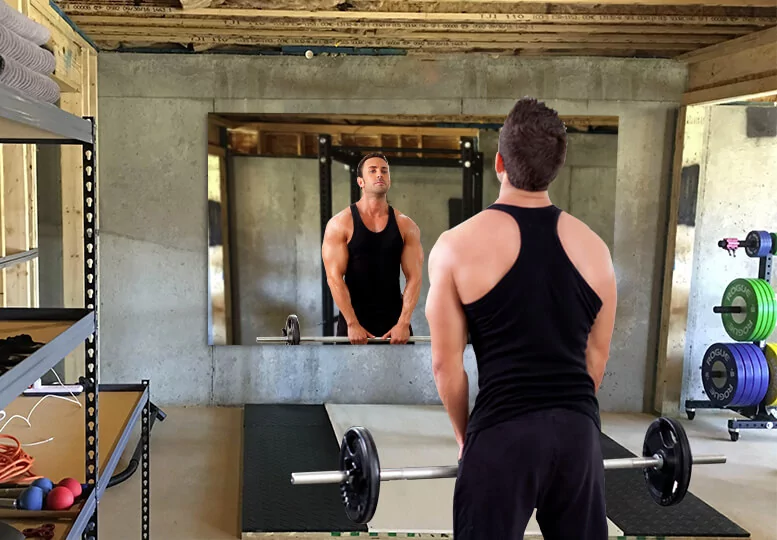
Creating the ultimate home fitness sanctuary requires more than merely hoarding dumbbells and investing in a high-tech treadmill. True gym optimization lies in crafting an environment that simultaneously motivates, elevates, and protects you. While the focus heavily leans toward mechanical equipment, fitness enthusiasts often neglect a surprisingly vital component of their training ecosystem. Integrating a Home Gym Workout Mirror with Safety Backing fundamentally transforms your space from a basic workout corner into a professional-grade studio. This subtle addition serves as your most honest personal trainer, ensuring precision in every movement while guaranteeing your space remains safe.
For decades, the standard protocol for building a home gym involved throwing some interlocking rubber mats onto a basement floor, buying a bench press, and calling it a day. However, as our understanding of kinesiology, biomechanics, and interior design has evolved, so too has the concept of the domestic workout space. Today, creating a dedicated fitness zone is about engineering an atmosphere conducive to peak performance. In this pursuit of perfection, the wall-mounted mirror emerges not as an instrument of vanity, but as a critical tool for athletic development and spatial harmony.
The Biomechanics of Visual Feedback
When you step into a commercial gym, you are instantly greeted by walls lined with massive panes of reflective glass. This ubiquitous design choice is not simply an aesthetic preference designed to make the room look modern; it is rooted in the deep biomechanical need for visual feedback during physical exertion.
Correcting Form in Real-Time
Proprioception—your body’s ability to sense its movement, action, and location—is incredibly powerful, but it is not infallible. When fatigue sets in during the fourth set of heavy squats, what feels like a perfectly neutral spine might actually be a dangerous lumbar curve. A home gym mirror provides instantaneous, objective feedback. It allows you to synchronize what you feel with what is actually happening.
When performing complex compound movements like deadlifts, overhead presses, or kettlebell swings, the margin for error is razor-thin. A slight deviation in your bar path or an asymmetrical hip hinge can drastically reduce the efficacy of the exercise. By watching your reflection, you engage in a continuous loop of visual motor integration. You see the misalignment, your brain processes the error, and you correct your posture in real-time. This dynamic adjustment simply cannot happen without a reflective surface.
Preventing Chronic and Acute Injuries
The natural byproduct of continuous form correction is injury prevention. Chronic injuries often stem from repetitive strain caused by micro-misalignments over weeks or months of training. Without visual feedback, you might consistently favor one leg during lunges or flare your elbows excessively during bench presses. Over time, these minor errors compound into tendinitis, rotator cuff tears, or lower back trauma. A high-quality workout mirror acts as a safeguard against these creeping bad habits, allowing you to catch and correct biomechanical flaws before they manifest as painful injuries.
The Crucial Innovation of Safety Backing
While the necessity of a mirror in a fitness space is undeniable, the type of mirror you install is a matter of paramount importance. A home gym is a dynamic, high-energy environment characterized by heavy, solid objects moving at high velocities. In this setting, a standard household mirror is not just inadequate; it is a profound safety hazard.
What Exactly is Safety Backing?
This brings us to the critical distinction of safety backing. Safety backing, often applied as a heavy-duty woven tape or a specialized adhesive polyethylene film applied to the rear of the glass, fundamentally alters the physical properties of the mirror when it undergoes trauma. Regular glass, when struck by a stray dumbbell or a swinging kettlebell, shatters into hundreds of jagged, razor-sharp shards that explode outward. This can cause catastrophic, life-altering lacerations, especially in an environment where people are often wearing minimal clothing and moving dynamically.
Safety-backed mirrors are engineered to mitigate this exact nightmare scenario. If a profound impact occurs, the glass will still break, but the safety film acts as an unyielding anchor. Instead of exploding across your gym floor, the broken pieces remain adhered to the backing.
Protecting Your Most Valuable Asset: You
The peace of mind this technology affords cannot be overstated. When you are pushing for a one-rep max, your sole focus should be on engaging your central nervous system and executing the lift. You should not be harboring a subconscious fear of a catastrophic glass explosion if you happen to lose your balance or drop a bumper plate too close to the wall.
Furthermore, home gyms are often shared spaces. If you have children or pets who might wander into the workout area when you are not there, the presence of safety-backed glass ensures that an accidental bump with a toy doesn’t result in a medical emergency. The safety backing effectively transforms a fragile pane of glass into a resilient, structurally sound piece of fitness equipment.
The Psychological Edge of Mirrored Training
Beyond the physical mechanics and safety protocols, installing a large mirror in your home gym taps into the complex psychology of human motivation and athletic performance. The environment we train in heavily dictates the intensity and consistency of our workouts.
Boosting Motivation and Self-Efficacy
There is a psychological phenomenon associated with observing oneself engaged in hard work. Seeing your muscles contract, watching the sweat form, and visually witnessing your own physical effort can significantly boost self-efficacy—your belief in your ability to succeed. When you can physically see yourself pushing through a difficult barrier, it reinforces a positive internal narrative. You transition from merely “doing a workout” to embodying the identity of an athlete.
This visual confirmation acts as a powerful intrinsic motivator. On days when your energy levels are low and the couch looks more appealing than the barbell, catching your reflection in your dedicated training space can serve as the spark needed to ignite your routine. It holds you accountable.
The “Enclothed Cognition” of the Gym Space
Psychologists often discuss “enclothed cognition,” the idea that the clothes we wear affect our psychological processes. A similar concept applies to our environments. A dark, cluttered basement feels like a storage room, and training in one can feel like a chore. However, when you add a sleek, wall-to-wall mirror, you immediately elevate the room’s status. It signals to your brain that you have entered a professional zone dedicated to self-improvement. The mirror acts as a psychological switch, helping you transition from the stresses of daily household life into a focused, aggressive, and productive training mindset.
Interior Design and Spatial Dynamics in Fitness Rooms
The integration of a gym mirror is not exclusively about physical training; it is also a masterful stroke of interior design. Home gyms are frequently relegated to the less desirable areas of a house—small spare bedrooms, unfinished basements, or cramped garages. These spaces are historically plagued by a lack of square footage and poor lighting.
Banishing the “Dungeon” Aesthetic
Nothing shrinks a room faster than dark, matte walls closing in on a bulky squat rack and a treadmill. By installing a large workout mirror, you instantly alter the perceived dimensions of the room. Mirrors are the oldest and most effective interior design trick for creating the illusion of space. The reflection essentially doubles the visual depth of the room, pushing the walls back and completely eliminating the claustrophobic “dungeon” aesthetic that plagues so many amateur home gyms.
This expansion of perceived space makes the room much more inviting. You are more likely to spend an hour training in a room that feels open, airy, and expansive than one that feels like a solitary confinement cell.
Amplifying Natural and Ambient Light
Furthermore, mirrors are unparalleled in their ability to manipulate light. Most basements and garages suffer from a distinct lack of natural sunlight. Even with overhead LED panels, the lighting can often feel harsh or uneven. A strategically placed mirror catches whatever light is available—whether from a small egress window or your overhead fixtures—and bounces it back into the room.
This light amplification drastically brightens the space, making it feel more vibrant and energetic. Proper lighting is essential for maintaining a high level of alertness and energy during a workout, and a mirror acts as a massive amplifier for your room’s lumens without requiring any additional electrical work.
Installation Insights and Best Practices
To reap the full physical, psychological, and spatial benefits of your safety-backed mirror, proper installation is key. This is not a piece of decor you simply hang from a single nail like a picture frame.
Optimal Sizing and Placement Angles
When determining the size and placement of your gym mirror, consider the types of exercises that dominate your routine. If your focus is primarily on yoga, Pilates, or bodyweight exercises that involve floor work, you will need a mirror that extends lower to the ground. Conversely, if your gym is built around Olympic weightlifting or a power rack, the mirror should be positioned to capture your entire body while standing, ensuring you can see the overhead lockout of a barbell.
As a general rule of thumb, the mirror should be mounted approximately 16 to 22 inches off the ground and extend upward to a height of at least 6 feet. This accommodates the visual needs of most users across a variety of movements.
Additionally, consider the distance between your workout station and the mirror. If you place your squat rack too close to the glass, you won’t have the necessary field of view to see your full body mechanics. Ensure there is adequate setback distance, usually a minimum of three to four feet between your primary lifting area and the mirror to allow for a comprehensive visual assessment of your form.
Conclusion
The construction of a home gym is an ongoing journey of refinement and optimization. While it is tempting to allocate your entire budget toward the heaviest iron and the most complex cardiovascular machines, doing so at the expense of proper visual feedback is a strategic error. A safety-backed mirror is not an accessory; it is a foundational element of a smart, secure, and effective training environment.
By investing in shatterproof, reflective technology, you are investing in your own biomechanical efficiency. You are safeguarding your body against the creeping dangers of poor form, protecting your space from the hazards of shattered glass, and transforming a dim, cramped room into a vibrant, expansive studio. Ultimately, the addition of a high-quality mirror ensures that every drop of sweat, every grueling rep, and every ounce of effort is executed with precision, safety, and unwavering purpose.