


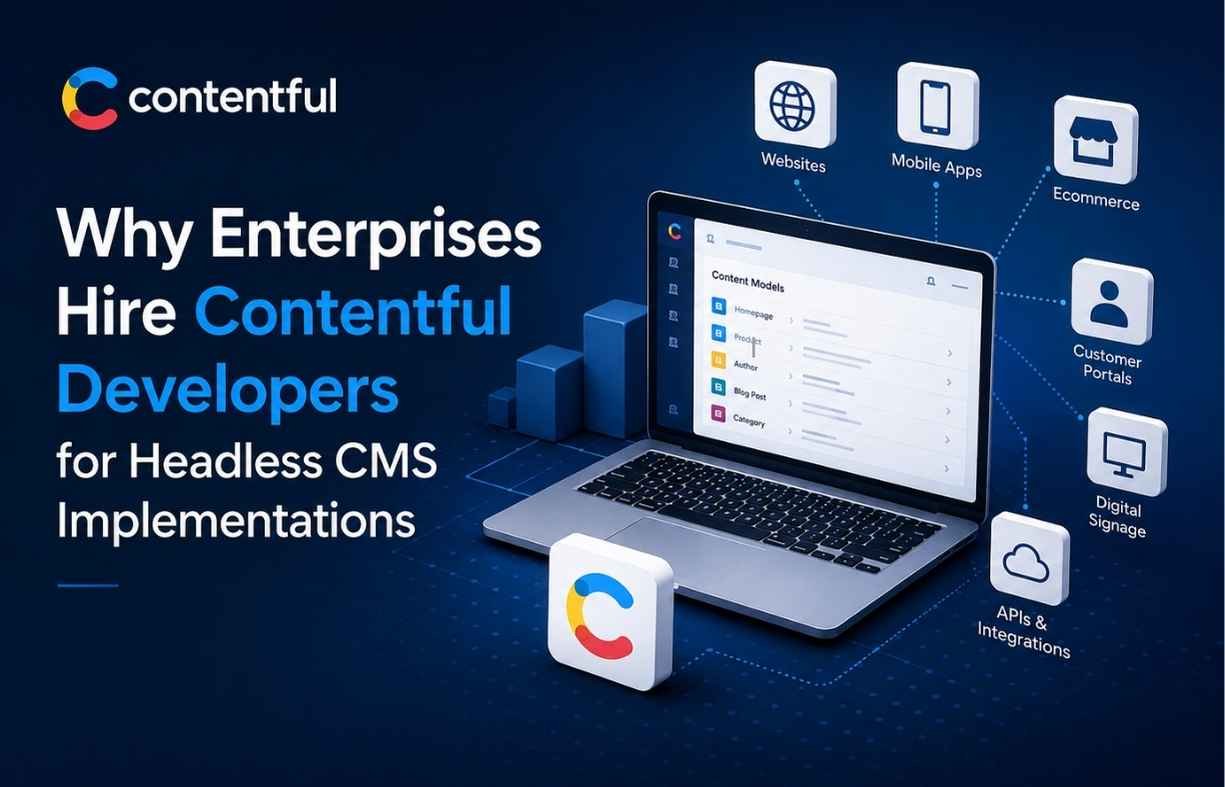
Organizations are increasingly moving away from traditional content management systems in favor of headless platforms that support modern digital experiences. Websites are no longer the only destination for content. The same content may need to appear across websites, mobile applications, customer portals, commerce platforms, digital signage, and emerging digital channels.
This shift has changed how content is managed, structured, and delivered. As a result, many organizations evaluating Contentful quickly realize that implementing a headless CMS involves more than selecting a platform. It requires careful planning around content architecture, governance, integrations, and long-term scalability. This is one of the primary reasons enterprises often choose to hire Contentful developer resources when planning a headless CMS implementation.
A successful Contentful implementation depends on decisions that affect content operations for years. Content models, API design, integration architecture, and governance frameworks all play a role in determining whether the platform becomes a scalable enterprise asset or an ongoing maintenance challenge.
What Makes Contentful Different from Traditional CMS Platforms
Traditional content management systems were designed around websites. Platforms such as WordPress, Drupal, and many legacy enterprise CMS solutions combine content management, presentation layers, and publishing functionality into a single environment.
This architecture works well for simple websites, but limitations often appear as organizations expand digital channels and content requirements.
For example, a marketing team may need to publish content to a website, mobile application, customer portal, and digital kiosk. In a traditional CMS, content is often tightly coupled with page layouts and templates, making reuse difficult.
Contentful Approaches Content Differently.
Instead of treating content as website pages, Contentful treats content as structured data. Content is created, stored, and managed independently from presentation layers. Applications retrieve content through APIs and determine how that content should be displayed.
This API-first approach provides flexibility, but it also introduces architectural considerations that many organizations have not previously encountered.
Questions such as content modeling, content relationships, localization structures, API performance, and governance become critical implementation decisions. This is often where specialized Contentful expertise becomes valuable.
Why Enterprises Hire Contentful Developer Resources for Strategic Implementations
Many organizations assume that a headless CMS implementation is primarily a development project. In reality, the most important decisions often occur before any front-end code is written.
The foundation of every Contentful implementation is the content model.
Content models define how information is organized, how content types relate to one another, and how content can be reused across channels. These decisions affect everything from editorial workflows to application performance.
An enterprise organization may have dozens of content types supporting products, services, resources, events, locations, knowledge articles, customer stories, and support documentation. Each content type may contain relationships to multiple other content entities.
Without proper planning, content structures can become difficult to maintain and expensive to modify later.
This is one reason enterprises frequently hire experienced Contentful developers during project planning rather than waiting until development begins.
Content Architecture Requires Long-Term Planning
Content architecture influences how efficiently content teams can operate.
A well-designed architecture supports:
- Content reuse
- Multi-language publishing
- Multi-brand websites
- Governance requirements
- Future channel expansion
Consider a global organization managing multiple regional websites. Product information may need to appear across dozens of countries while maintaining local translations and region-specific messaging.
If the content architecture does not account for these requirements early in the implementation, future expansion often requires substantial redesign.
Experienced Contentful developers understand how to design structures that support current business requirements while remaining flexible enough to accommodate future growth.
Poor Content Models Are Expensive to Fix
Unlike visual website changes, content model decisions affect nearly every connected application.
A poorly designed content model can create challenges such as:
- Duplicate content creation
- Inefficient publishing workflows
- Complex API responses
- Difficult localization processes
- Front-end development constraints
Correcting these issues often requires rebuilding content types, migrating content, updating APIs, and modifying front-end applications.
Organizations frequently discover that redesigning content architecture after launch is significantly more expensive than investing in proper planning at the beginning of the project.
Contentful Developers Build Enterprise Content Models
One of the most important responsibilities of a Contentful developer is designing structured content models.
Enterprise websites rarely consist of simple pages. Instead, they contain interconnected content entities that support multiple business functions.
For example, a resource article may reference:
- Authors
- Categories
- Products
- Industries
- Downloadable assets
- Related articles
Rather than duplicating information across multiple pages, Contentful developers create reusable content structures that maintain consistency throughout the platform.
Content modeling also affects content governance. Structured content allows organizations to enforce standards around metadata, taxonomy, localization, and publishing workflows.
Taxonomy design is another area where specialized expertise becomes important.
Categories, tags, metadata fields, and search attributes influence content discoverability and user experience. A taxonomy framework that appears sufficient during initial development may become difficult to manage as content volume increases.
Experienced Contentful developers design content structures that support both editorial teams and technical systems.
API Integration Is a Major Reason Enterprises Hire Contentful Developers
Contentful rarely operates in isolation.
Most enterprise implementations require integrations with existing business systems.
Common integration scenarios include:
- Salesforce CRM
- HubSpot
- Marketo
- Digital asset management platforms
- Product information management systems
- ERP applications
- Analytics platforms
These integrations enable content to move between systems while maintaining consistency and governance.
For example, product information managed in an ERP system may need to appear within Contentful-driven websites and customer portals. Marketing content may need to reference CRM data for personalization initiatives.
Developing these integrations requires understanding APIs, webhooks, middleware architectures, and data synchronization strategies.
A Contentful developer must determine how data should move between systems, how updates should be handled, and how integration failures should be monitored.
Poor integration planning often creates operational inefficiencies that affect multiple departments.
This is why Contentful API integration work typically requires architectural planning rather than simple technical implementation.
Multi-Site and Multi-Brand Governance Requires Specialized Expertise
Enterprise organizations frequently manage multiple websites across brands, regions, and business units.
A single Contentful environment may support:
- Corporate websites
- Regional websites
- Product websites
- Customer portals
- Partner portals
While this consolidation can improve efficiency, it also introduces governance challenges.
Questions often arise regarding:
- User permissions
- Editorial responsibilities
- Publishing approvals
- Environment management
- Content ownership
Without governance controls, organizations risk creating content duplication, inconsistent messaging, and operational confusion.
Contentful developers help establish governance frameworks that support collaboration while maintaining control.
This includes designing roles, permissions, workflows, and environment strategies that align with organizational requirements.
Governance becomes particularly important in regulated industries where content changes may require approval processes and audit visibility.
Headless CMS Performance Depends on Proper Architecture
Headless CMS platforms are often associated with performance improvements, but these benefits are not automatic.Performance depends heavily on implementation decisions.
API design plays a major role in determining how efficiently content can be delivered to applications.
Poorly designed content structures may result in excessive API requests, large payloads, or inefficient content retrieval patterns.
Contentful developers evaluate how applications consume content and design APIs accordingly.
Caching strategies also influence performance outcomes.
Enterprise Implementations Frequently Leverage:
- Content delivery networks
- Edge caching
- Static site generation
- Incremental content updates
Front-end frameworks such as React, Next.js, Gatsby, and Nuxt can further improve performance when implemented correctly.
However, these technologies require alignment with content architecture and delivery strategies.
Performance optimization therefore becomes both an architectural and development consideration.
Contentful Developers Help Avoid Common Implementation Mistakes
Organizations implementing Contentful for the first time often encounter similar challenges.
One common issue involves overcomplicating content models.
In an attempt to account for every possible future scenario, teams sometimes create excessive content types and relationships. This increases complexity without providing meaningful business value.
Another common mistake is content duplication.
Without reusable content structures, editors may create multiple versions of similar content, making updates difficult and increasing governance risks.
Localization planning is another frequent challenge.
Organizations that postpone localization decisions until after launch often face significant rework when expanding internationally.
Environment management can also create complications.
Development, testing, staging, and production environments require clear processes for deployment and content promotion. Without structured governance, teams may struggle to maintain consistency across environments.
Experienced Contentful developers have encountered these scenarios before and can help organizations avoid unnecessary complexity.
Migration Projects Often Require Experienced Contentful Developers
Many Contentful implementations involve migration from existing CMS platforms.
Common migration sources include:
- WordPress
- Drupal
- Sitecore
- Adobe Experience Manager
- Custom CMS platforms
Migration projects involve much more than moving content from one system to another.
Organizations must first understand what content exists, how it is structured, and whether it remains relevant.
A content inventory often reveals duplicate, outdated, or poorly organized information that requires remediation before migration begins.
Once content has been evaluated, mapping exercises determine how legacy content aligns with new Contentful structures.
Content relationships, metadata, localization requirements, and asset management strategies must all be considered.
Migration tooling can automate portions of the process, but human oversight remains essential.
Successful migrations depend on both technical execution and content governance planning.
How Contentful Developers Support Omnichannel Content Delivery
One of the primary benefits of a headless CMS is the ability to distribute content across multiple channels from a single source.
Enterprise organizations increasingly publish content to:
- Websites
- Mobile applications
- Customer portals
- Commerce experiences
- Internal applications
- Emerging digital channels
Rather than maintaining separate content repositories for each platform, Contentful enables structured content reuse.
For example, a product description may be used simultaneously within a website, mobile application, commerce platform, and customer support portal.
Contentful developers design content structures that support this level of reuse while maintaining governance and consistency.
The result is not simply faster publishing. It is a more sustainable content operating model that reduces duplication and improves content quality.
When Should an Organization Hire a Contentful Developer?
Organizations often benefit from Contentful expertise during several key scenarios.
The first is a new Contentful implementation. Early architectural decisions typically have the greatest long-term impact.
CMS migration projects also benefit from specialized expertise because content mapping, governance, and integration requirements can become complex.
Organizations expanding into multiple languages frequently require assistance designing scalable localization frameworks.
Companies integrating Contentful with Salesforce, ERP systems, or marketing technology platforms often require technical expertise around API architecture and data synchronization.
Website modernization initiatives also create opportunities to hire Contentful developer resources who understand both headless CMS architecture and enterprise content operations.
In most cases, organizations achieve better outcomes when Contentful expertise is involved during planning rather than after implementation challenges emerge.
Should You Hire a Contentful Developer or a Contentful Development Company?
The answer depends largely on project scope and organizational requirements.
An individual Contentful developer may be suitable for smaller implementations, focused enhancements, or organizations with strong internal architecture teams.
This approach can provide flexibility and lower short-term costs.
However, larger enterprise projects often require expertise across multiple disciplines, including content architecture, front-end development, integrations, governance, and migration planning.
A Contentful development company may provide broader coverage across these areas while supporting larger implementation efforts.
Organizations should evaluate project complexity, internal capabilities, governance requirements, and long-term support needs when determining the most appropriate engagement model.
The decision is rarely about development alone. It is often about access to architectural expertise and implementation experience.
Summary
Contentful implementations are fundamentally architecture projects that happen to involve content management technology.
The success of a headless CMS initiative depends on decisions surrounding content modeling, governance, API integration, localization, migration planning, and long-term scalability.
Organizations that view Contentful as simply another CMS often underestimate the importance of these decisions. Those that invest in proper planning typically create content platforms capable of supporting multiple channels, regions, and business requirements over time.
This is why many enterprises choose to hire Contentful developer expertise early in the implementation process. The goal is not simply to build a website. It is to establish a structured content foundation that can support future digital initiatives while maintaining operational efficiency and governance.