


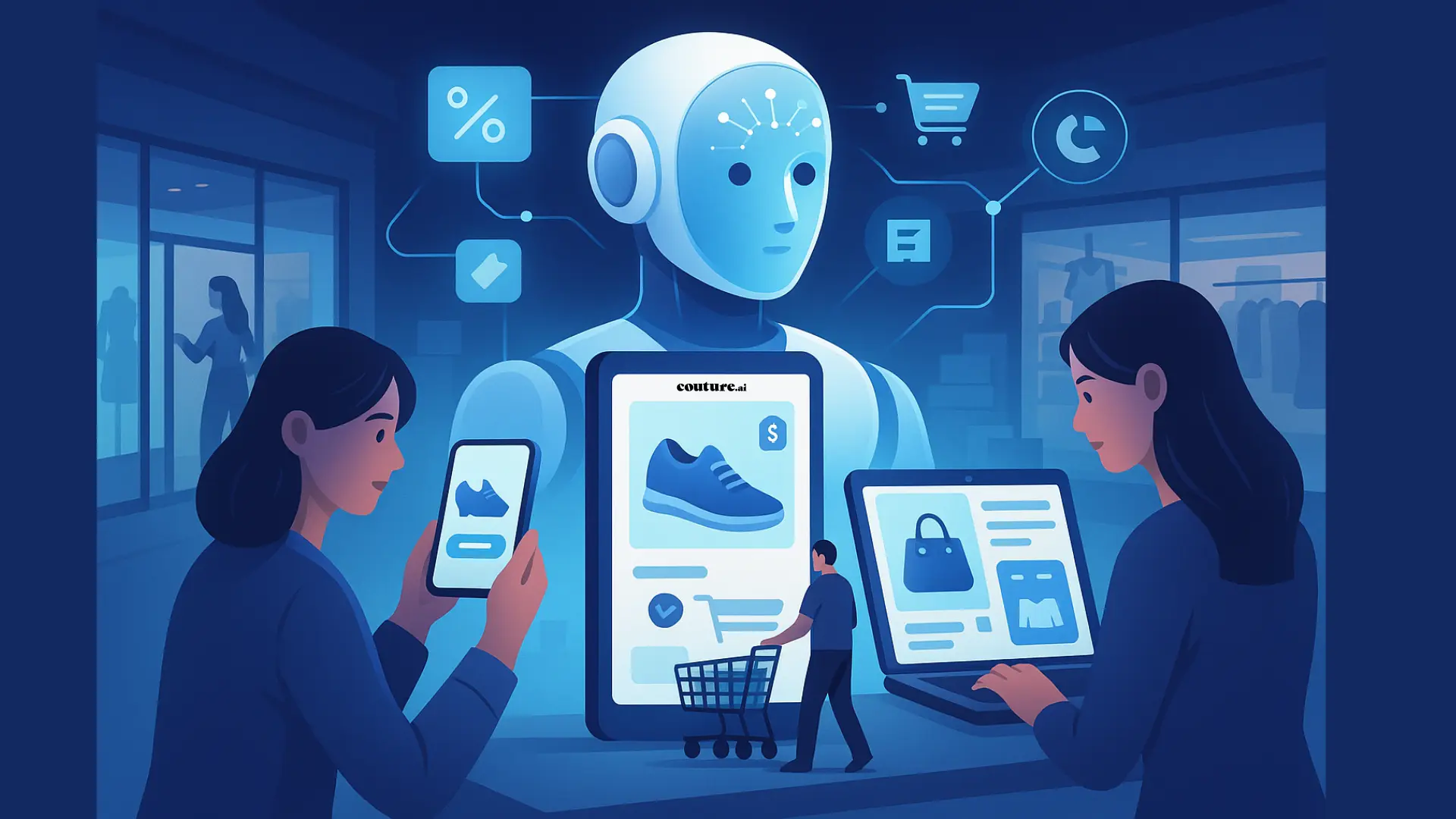
Customers do not think in channels. They browse on mobile, ask questions in chat, check store availability, follow up by email, and expect every interaction to feel connected. That is where many retail experiences still break down.
Teams may have strong tools in place, but when systems, service, and fulfillment do not move together, the customer feels the gap immediately. That is why AI Agents in Retail for Omnichannel Experience is becoming a more serious operational priority, not just another automation trend.
In this guide, you will see where these agents create value, what strong deployments get right, and where human oversight still matters.
Where AI Agents Actually Improve the Omnichannel Experience
AI agents add the most value where retail teams need speed, continuity, and action across channels, not just better replies.
- Product discovery: They guide shoppers with relevant recommendations, answer buying questions, and keep context consistent across chat, site, app, and messaging touchpoints.
- Cart recovery: They follow up with personalized nudges, resolve hesitation in real time, and help customers return to checkout without restarting the conversation.
- Order support: They handle tracking, delivery updates, cancellations, and simple changes across channels, reducing friction while keeping service fast and consistent.
- Returns and exchanges: They simplify return requests, explain policies clearly, and coordinate next steps without forcing customers to repeat details across touchpoints.
- Post-purchase retention: They trigger reorders, loyalty reminders, and tailored support based on customer behavior, making AI agents in retail omnichannel more commercially useful.
Used well, they strengthen the full customer journey, not just one service moment.
The New Retail Standard. One Agent Layer Across Commerce, Service, and Operations
Retail teams are moving toward one connected agent layer that links customer experience with execution, instead of running separate automations inside separate tools.
- Shared context: One agent layer carries customer intent, order history, and preferences across commerce, service, and operational touchpoints.
- Connected actions: It does not just answer questions; it updates orders, triggers workflows, and coordinates next steps across systems.
- Faster execution: Teams reduce delays when agents connect storefront, CRM, inventory, fulfillment, and support operations in one flow.
- Stronger consistency: Customers get the same brand logic, policy handling, and service continuity across digital and assisted channels.
- Better scale: Retailers expand service coverage without creating more fragmented tools, teams, or customer handoff points.
In 2025, U.S. e-commerce sales accounted for 16.4% of total retail sales, showing why connected retail operations matter more now.
What Strong Retail AI Agent Deployments Have in Common
The strongest deployments do not start with a flashy assistant. They start with the systems, rules, and operating discipline needed to support consistent omnichannel execution.
- Connected Data Foundations
Strong retail agents need reliable access to the information that shapes real customer interactions.
- Unified context: They pull customer, order, inventory, and support data into one working view so conversations stay accurate across channels and touchpoints.
- Live system access: They work best when they can read and update ecommerce, CRM, fulfillment, and service platforms in real time.
- Clear Decision Boundaries
Good deployments define what the agent can handle, what it should escalate, and where human review still matters.
- Task limits: Teams set clear rules around refunds, exceptions, policy-sensitive cases, and other actions that require tighter operational control.
- Escalation logic: The handoff path is defined early, so customers move to a human smoothly when confidence, complexity, or risk changes.
- Measurable Operational Ownership
Retail teams get better results when agent performance is treated like an operating function, not a side experiment.
- Shared accountability: Ecommerce, CX, operations, and IT align on goals, ownership, and the workflows the agent is expected to improve.
- Practical metrics: Teams track containment, resolution quality, repeat contacts, conversion influence, and speed to action, not just response volume.
In the fourth quarter of 2025, U.S. retail e-commerce sales accounted for 18.3% of total retail sales, which shows why retailers need AI agents in retail omnichannel that can connect digital demand with operational follow-through.
The Best Omnichannel Retail Workflows to Prioritize First
Retail teams should start with workflows that are repetitive, cross-channel, and closely tied to customer experience or revenue.
- Order tracking: High-volume status questions are easy to automate and improve service consistency across chat, email, messaging, and self-service channels.
- Returns support: Agents can guide return requests, explain policies, and route next steps faster when the workflow is structured and rules-based.
- Cart recovery: Timely follow-up across channels helps recover demand when agents can answer objections and reconnect shoppers to active purchase intent.
- Inventory checks: Real-time stock visibility across stores and digital channels helps customers make faster decisions and reduces avoidable support contacts.
- Reorder journeys: Repeat purchase reminders work well when agents use purchase history and channel context to prompt action at the right time.
These workflows create fast operational wins without forcing teams to automate complex judgment too early.
Where Retail Teams Still Need Human Control
AI agents can handle repetitive work well, but retail teams still need human control in moments that affect trust, judgment, or policy.
- Escalated complaints: Frustrated customers often need empathy, flexibility, and brand judgment that automated workflows cannot handle consistently.
- Fraud cases: Payment disputes, suspicious activity, and account risk decisions require tighter review and stronger human oversight.
- Policy exceptions: Refund overrides, special accommodations, and edge-case service decisions need people who can interpret context carefully.
- VIP relationships: High-value customers often expect more tailored handling than a generalized agent flow should provide.
- Quality oversight: Teams still need humans to review conversations, spot failures, and improve workflows before small issues spread.
The goal is not full replacement. It is a better division of work between automation and judgment.
How Retail Leaders Should Evaluate AI Agents for Omnichannel Experience
Retail leaders should evaluate AI agents based on operational fit, not demo quality alone.
- Channel coverage: Check whether the agent can support web, app, messaging, and service touchpoints without breaking context between them.
- System access: It should pull live data and complete actions across commerce, CRM, support, and fulfillment systems.
- Handoff quality: Strong agents pass conversations to humans with full context instead of forcing customers to repeat information.
- Control model: Review permissions, escalation rules, and policy boundaries before rollout, not after problems appear.
- For teams testing new approaches, it can also be useful to try AI agents with no code before committing to a larger implementation.
- Business impact: Measure value through resolution speed, service consistency, conversion support, and repeat contact reduction.
The best evaluation lens is practical, whether the agent improves the customer journey while reducing operational friction across channels.
The Risks That Stall Omnichannel AI Agent Projects
Most retail AI agent projects stall for operational reasons, not because the idea is weak.
- Disconnected systems: Agents struggle when ecommerce, CRM, inventory, and support platforms do not share clean, real-time data across channels.
- Weak workflow design: Teams often automate replies before defining actions, approvals, escalation paths, and ownership across functions.
- Poor success metrics: Measuring deflection alone misses what matters in retail, including continuity, resolution quality, and commercial impact.
- Over-automation: Retailers lose trust when agents handle exceptions, policy decisions, or emotional service moments without enough human control.
- No governance: Quality drops fast when teams launch without testing, monitoring, and clear accountability.
The projects that scale are the ones built like operating systems, not side tools.
What Retail Omnichannel Experience Looks Like Over the Next 12 Months
Over the next year, retail omnichannel experience will become more connected, more proactive, and more agent-led.
- Unified commerce: Retailers will keep pushing toward shared inventory, order, and customer visibility across channels.
- Proactive service: Agents will resolve issues earlier through updates, reminders, and next-step guidance before customers ask.
- More personalization: Retail teams expect AI to improve tailored experiences across digital and assisted journeys.
- Operational coordination: AI use will expand beyond service into fulfillment, inventory visibility, and supply chain support.
- Agentic shopping pressure: Retailers will increasingly need to serve both human shoppers and AI assistants acting on their behalf.
The winners will be the retailers that connect experience and execution in one flow.
Conclusion
Retailers do not need more disconnected automation. They need systems that help teams respond faster, carry context across channels, and support better execution from discovery to post-purchase service. That is where AI Agents in Retail for Omnichannel Experience can create real value. The strongest results will come from focused workflows, connected data, and clear human oversight, so the experience feels consistent for customers and more manageable for the teams running it.
FAQs
- What are AI agents in the retail omnichannel experience?
They are AI systems that help retailers manage customer interactions across channels while keeping context, actions, and service more connected.
- How do AI agents in retail omnichannel experience improve customer journeys?
They reduce repeated questions, speed up support, and help shoppers move more smoothly between browsing, buying, delivery, and post-purchase service.
- Where do AI agents in retail omnichannel experience work best?
They work best in structured, high-volume workflows such as order tracking, returns support, inventory checks, and cart recovery.
- Do AI agents in retail omnichannel experience replace human teams?
No. They handle repetitive tasks well, while human teams still lead on exceptions, complaints, policy decisions, and sensitive customer situations.
- What should retailers check before adopting AI agents in the retail omnichannel experience?
They should review system integrations, data quality, escalation design, workflow fit, and how performance will be measured after launch.