


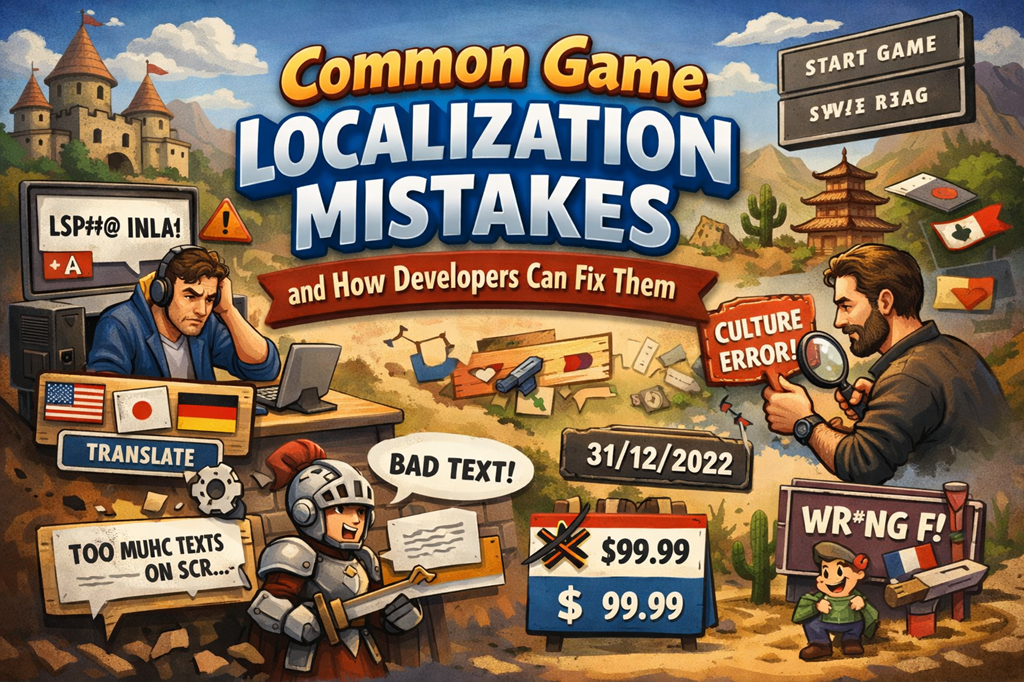
You’ve spent years in the trenches of development. You’ve survived “crunch,” wrestled with game-breaking bugs, and poured your soul into every frame of lighting. But then you launch globally, and the Steam reviews start trickling in. Instead of praising your combat system, players in Seoul are laughing at your nonsensical dialogue. Players in Paris are frustrated because the UI is functionally unreadable.
It’s heartbreaking. I’ve watched multi-million dollar projects hit a brick wall because they treated localization like a final “to-do” item rather than a core system.
If you think localization is just a simple word swap, you’re setting yourself up for a “lost in translation” disaster. A high-stakes RPG can turn into a slapstick comedy overnight if the tone is off. To truly land with a global audience, you have to stop thinking about “translation” and start thinking about the player’s lived experience.
Let’s get into the actual pitfalls that ruin games and how to make sure yours isn’t one of them.
1. Hard-Coding: The Developer’s Hidden Debt
There’s a specific kind of dread that sets in when you realize you’ve hard-coded your text. In the heat of development, writing Debug.Log(“Game Over”) or sticking text directly into a prefab feels efficient. It’s not. It’s technical debt that compounds with every new language you add.
When you finally hire a game localization service provider, you don’t want your lead programmer wasting 40 hours a week tracking down strings hidden in scripts. It’s a soul-crushing task that leads to missed deadlines and broken builds.
The Fix: Build a “translation-agnostic” engine. Use external spreadsheets or JSON files that a video game translation company can work on without ever seeing your source code. If a translator can’t edit it without opening the IDE, you’ve already made your first mistake.
2. The “Accordion Effect” of Language
English is unusually compact. We say “Play,” and it’s four letters. In German, you’re looking at “Spielen.” In French, maybe “Commencer.” This is what we call the “accordion effect”: languages expand and contract, and your UI needs to breathe with them.
I can’t tell you how many games I’ve played where the Japanese text is microscopic to fit a tiny box, or the Russian translation is simply cut off at the edge of the screen. It looks unpolished, and it tells the player you didn’t care enough to check.
The Fix: Design for the “longest case.” If your UI doesn’t have 30% extra padding, it’s going to break. Use auto-wrapping and dynamic scaling. A partner like CCJK can give you a “word count expansion” forecast so your artists aren’t doing emergency UI overhauls two days before launch.
3. Contextual Blindness: When Strings Lose Meaning
Imagine being handed a spreadsheet with the single word “Home.” Is it the “Home” button on a menu? Is it a character talking about their “home” village? Or is it a verb, like “to home in on a target”?
If you just ship a list of strings to a video game translation company without context, you’re basically playing a game of Telephone with your own IP. Translators can’t infer intent without context. When they guess wrong, your character’s epic monologue suddenly sounds like a mechanically translated Google Translate.
The Fix: Stop the guessing game. Give your linguists a “Loc Kit” with screenshots, character bios, and even video clips of key scenes. When a team like CCJK knows who is talking and why, the translation stops being a list of words and starts functioning as written dialogue rather than raw text.
4. Cultural Blind Spots: Beyond the Alphabet
This is the most critical issue. Localization isn’t just about grammar; it’s about not accidentally offending large segments of your audience. I’ve seen games get banned or “review-bombed” because of a color choice that meant “death” in one culture or a hand gesture that was an obscene insult in another.
Humor is notoriously difficult. A witty one-liner in London might fall completely flat in Tokyo, or worse, come across as aggressive. You aren’t just translating words; you’re translating vibes.
The Fix: You need native eyes on the project early. You need people who live in the target culture to flag “cringe” moments before they go live. This is “culturalization,” adjusting the intent of the game to fit the local market without losing what makes it special.
5. The Costliest Error: Skipping LQA
Linguistic Quality Assurance (LQA) is usually the first thing to get cut when the budget gets tight. “The translators are pros,” developers say. “They don’t need a double-check.”
That assumption is wrong. LQA isn’t about checking spelling; it’s about seeing how the text lives in the game. Does the font support the characters? Does the text advance too fast to read? Is the tone consistent across a 40-hour campaign? Without a final play-through by a native gamer, you are flying blind.
The Fix: Don’t ship a “blind” localization. Budget for a native-speaker play-through. It’s the difference between a game that feels “translated” and a game that feels native to that country.
Wrapping Up
Localization is the bridge between your vision and a global community. It’s an investment in respect. When you avoid these common traps, such as hard-coding, lack of context, and rigid design, you aren’t just making your game available. You’re making it accessible.Hire a video game translation company that understands the difference between a “technical manual” and a “living world.” Using a service like CCJK gives you the peace of mind that your story will hit just as hard in Brazilian Portuguese as it does in the original English.