


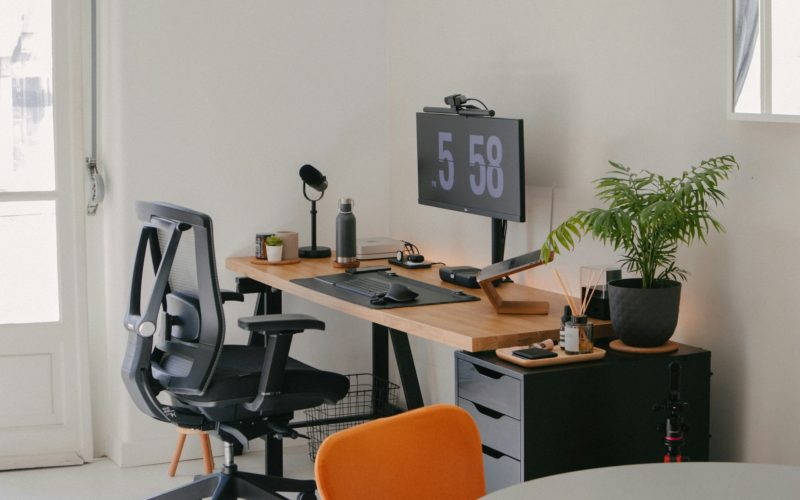
Remote work has seen explosive growth with a 159% increase from 2019 to 2021, outpacing the 37% increase in gaming hardware. This parallel boom in remote work has led to a rapid rise in demand for multi-use workspaces and an evolution in the way people are thinking about traditional desk design.
The emergence of hybrid functionality
Office furniture was originally designed around traditional office desks, which were not specifically designed with RGB lighting, dual-monitors, or gaming setups in mind. However, office furniture is evolving to accommodate multimedia needs while still looking professional enough for dissemination of serious business documents such as quarterly financial reports.
Products have to be rethought in terms of how we are going to use them in our homes; how will we organise our home office, games room around a desk. The organisational task of the desk to manage cables can be similar to that of a server room. Modularity will be crucial with future furniture designs to allow for a huge variety of usage and flexibility. Furthermore high specification furniture that once looked industrial and ugly can now look beautiful and be functional enough to support multiple screens. It is beautiful enough to be displayed on a wall.
Space optimization drives design innovation
Urban spaces are becoming increasingly congested and as a result, typical modern urban dwellings have adapted to accommodate the need for multi-functionality. The individual rooms are now mini-salons of multipurpose use: beds, workstations and lounges all sharing the same modest footprint. There is little room for lingering and admiring the beauty of interior design and decoration.
The designs of desks in recent years have moved towards a vertical orientation, incorporating more surface area in to a smaller amount of real-estate. What used to be an optional feature on desks is now the standard height adjustment mechanism. But height adjustment is not enough, manufacturers are looking into the next generation and how a desk can be height adjusted even more rapidly to support both standing and a lowered seat position, perhaps even suited to gaming. You may need to sit for a video call or to watch a screen for longer periods. Or maybe you need to switch between standing and sitting for a variety of tasks with in the one hour.
Material choices reflect dual demands
While regular office furniture serves well enough in a work space, regular office furniture does not serve well enough in a gaming space. Office furniture meant for desks need to be able to accommodate high-heat graphics cards and rapidly rotating gaming computers in addition to accurately viewing furniture with LED strips and multiple colors of light, whether it is artificial or natural.
Manufacturers of keyboards have focused on the lifespan of the switches and how they can be paired with relevant devices and equipment, such as mousepads. Furthermore, the surface of the keyboard itself has changed over time with many manufacturers opting for durable and aesthetically pleasing materials such as tempered glass or high quality engineered wood. For professional and casual users alike, custom printed desk mats provide the perfect solution for protecting surfaces at home, and can serve as a focal point for live video calls and gaming content streamed to social media platforms.
Surface protection becomes style
Initially introduced to the furniture range to offer protection from knocks and scratches, dividers have been widely adopted by our customers as part of their office design. Quickly and simply, a divider can change the feel and functionality of a workspace, turning it into a platform for client presentations or even playing video games.
Technology integration drives structural changes
Cable for power and data services are typically what businesses require for hybrid configurations. However, when setting up your gaming PC, cable for streaming media devices, your monitors, keyboards, mice, and more also needs to be accomodated. Managing all of these cables can be a chore and unsightly when set up improperly.
Many manufacturers are now incorporating solutions into the desk itself. Most products offer at least a built-in power strip, USB ports, or some sort of cable management solution. A few will even incorporate wireless charging pads or slots for hot gear. But the best products try to keep these solutions out of sight.
For video calls and professional videos, a clean background is important. For a gamer, that background is often a showcase of their desktop’s most powerful hardware. We have created professional cable management solutions which can be configured in an instant. These products enable users to show off their hardware, while keeping cables tidy. We also offer a selection of modular gaming desk accessories that can be configured to fit a gamer’s needs at the moment.
Market response and future implications
Initially, companies that made furniture for homes and offices got into making furniture for gamers, hoping to find a new market to expand into. But soon they realized that this new market wasn’t for them either. They have moved on to focus on the corporate purchasing world and a more traditional demographic. Meanwhile, companies that specialize in video gaming furniture and decor are having a hard time keeping up with the high demand for these unique products.
As organisations became more familiar with the capabilities of IT a new market gap appeared between what IT could do and what users wanted. Entrepreneurs seized the opportunity to create new companies quickly developing open, modular systems that could evolve as requirements changed. Modules could be swapped in, customised or hidden at cost to meet immediate needs.
With most of the world under lockdown and conducting their daily lives from home, the stereotypical image of the remote worker as a gamer or content creator has become the new normal. But just as this group is no longer the niche it once was, their workspaces must evolve to reflect the ever-changing landscape of shared activities at home.
Design in interiors is shifting, the major trend being that furniture is no longer designed with a single function, meaning designers and users have to consider that one surface will function as a place to check the company’s finances in the morning, and then hours later it will be where you’re live streaming to your clients in the evening. Just another compromise I suppose dressed up under the banner of innovation.