


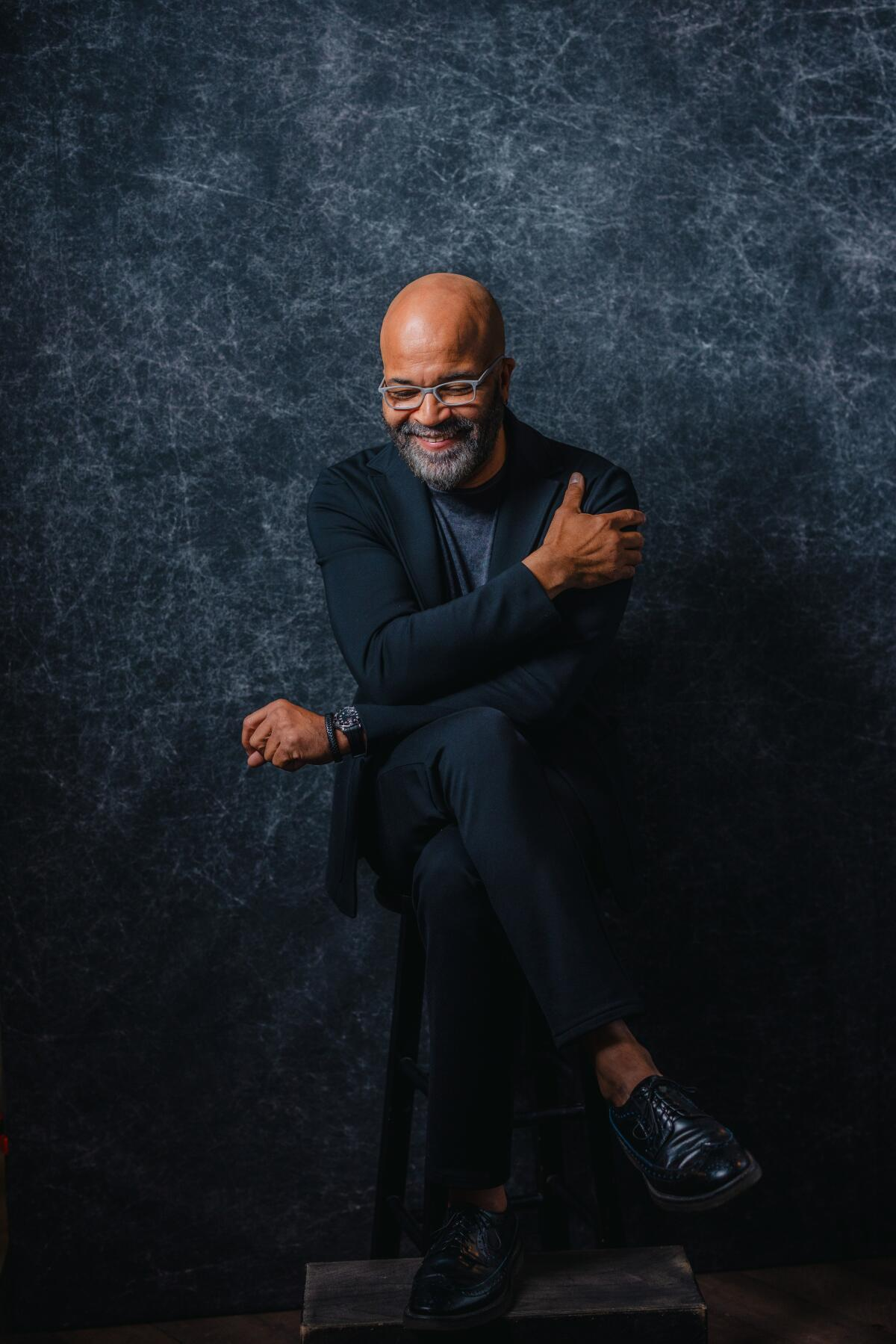
Jeffrey Wright has spent more than three decades playing men who seem to understand the room before anyone else does. His characters listen closely, speak with purpose, and often conceal more than they reveal. It has also allowed him to move between independent films and giant franchises without becoming trapped by either.
Many viewers knew Wright’s face long before they knew his name. He was Jean-Michel Basquiat, the artist surrounded by fame and exploitation. He was Felix Leiter, James Bond’s dependable American ally. He was Beetee, the technically gifted rebel in The Hunger Games. He became Bernard Lowe, the troubled architect of artificial life in Westworld, and later brought a tired, ethical Commissioner Gordon to The Batman. Each performance felt distinct, although Wright rarely relied on showy gestures.
His career becomes more interesting when examined outside a list of credits. Wright studied political science and considered law before choosing acting. He won a Tony Award early but spent years moving between lead roles and sharply drawn supporting parts. Away from the set, he became involved in development and mining projects in Sierra Leone. His first Academy Award nomination did not arrive until American Fiction, nearly 30 years after his breakthrough film role.
That path was not a simple rise from obscurity to fame. Wright repeatedly chose difficult material, worked across different forms, and resisted the pressure to become one fixed type of actor. His story explains how a reserved performer built an unusually varied career without making celebrity itself the main event.
The Political Science Graduate Who Walked Away From Law
Jeffrey Wright was born in Washington, D.C., on December 7, 1965. His father died when Wright was young, leaving his mother, Barbara Evon Whiting-Wright, and his aunt to play roles in his upbringing. His mother worked as a customs lawyer, so professional ambition, public institutions, and the law were not abstract ideas.
Washington also gave Wright an early education in power. The city contains the visible machinery of the American government, but it also consists of neighborhoods whose daily lives rarely resemble official ceremonies. Wright grew up amid both realities. That background later helped him portray political figures without reducing them to public speeches or familiar photographs.
Wright attended St. Albans School, a private boys’ school in Washington, before enrolling at Amherst College in Massachusetts. He studied political science and graduated in 1987. Acting was present during college, but it did not initially look like a secure profession. He considered law school and appeared ready to follow a path that matched his education and family background.
The decisive change came when performance proved more compelling than legal study. Wright enrolled at New York University’s Tisch School of the Arts but stayed for only a short period. He left formal training and began learning through professional work instead. The decision reveals an important feature of his career: he respects preparation, but he does not confuse credentials with ability.
Wright joined The Acting Company, the touring classical theater group founded by John Houseman and Margot Harley. Touring demanded discipline rather than glamour. Actors performed established texts, adapted to new venues, and repeated difficult material for changing audiences. The experience gave Wright a foundation in voice, movement, timing, and ensemble work.
Wright played Belize, a gay Black nurse and former drag performer who acts as friend, critic, caretaker, and moral witness. The role requires wit, anger, tenderness, and control. Belize must confront racism and homophobia while caring for people who may not deserve his generosity. Wright rejected any simple presentation of the character as either saint or comic relief.
His performance in Angels in America: Perestroika earned the 1994 Tony Award for Best Featured Actor in a Play. The achievement came early, when he was still establishing himself outside theater. More unusually, Wright returned to Belize about a decade later in Mike Nichols’s HBO adaptation. He was the only principal performer from the original Broadway cast to repeat his role for television.
The screen version required adjustment. Stage acting projects energy across a theater, while the camera notices minute changes in expression. Wright preserved Belize’s sharpness but brought the performance inward. He also played Mr. Lies and one of the Continental Principalities, showing his range within the same production. The work earned him an Emmy and a Golden Globe, giving him major theater and television awards for versions of the same character.
That rare continuity makes Belize more than an early success. The role documents Wright’s development across two mediums. It also established a pattern: he often plays intelligent men who see institutional hypocrisy clearly but still carry personal obligations inside those institutions.
Basquiat and the Skill of Playing a Real Person
Wright’s first major film lead arrived through an uncertain route. He played artist Jean-Michel Basquiat in Julian Schnabel’s 1996 film Basquiat, even though he did not have an agent when he secured the part. The absence of standard industry machinery suited a film about a gifted outsider entering an art world eager to package him.
Basquiat was difficult to portray because his public image had already become a collection of symbols. The crown, dreadlocks, expensive paintings, downtown clubs, friendship with Andy Warhol, drug use, and death at 27 could easily produce an imitation rather than a person. Wright concentrated on the tension between Basquiat’s sensitivity, ambition, humor, suspicion, and desire for recognition.
Wright worked opposite a remarkable cast that included David Bowie as Andy Warhol, Benicio del Toro, Claire Forlani, Dennis Hopper, Gary Oldman, Christopher Walken, and Willem Dafoe. Bowie’s relaxed, observant Warhol created a particularly strong contrast with Wright’s guarded Basquiat. Their scenes show affection, commerce, racial imbalance, and mutual fascination without explaining every tension aloud.
The film generated critical respect but did not turn Wright into a conventional movie star. Its theatrical release was limited, and its subject sat outside the safest commercial categories. Wright later described American Fiction as a kind of bookend to Basquiat. Both films center on Black artists trying to protect intellectual freedom while institutions reward narrower versions of their identity.
After Basquiat, Wright became a frequent choice for historical roles. He played Martin Luther King Jr. in the 2001 HBO film Boycott, which focused on the Montgomery bus boycott. Wright did not approach King as a monument. He presented a young leader dealing with strategy, fear, family pressure, competing personalities, and the consequences of public decisions.
Wright later portrayed painter David Hockney in a brief appearance in Surviving Picasso, musician Muddy Waters in Cadillac Records, and Colin Powell in Oliver Stone’s W. He voiced Black Panther Party co-founder Bobby Seale in the animated documentary Chicago 10. In Rustin, he played Adam Clayton Powell Jr., the influential congressman whose political maneuvering helped push Bayard Rustin away from the civil rights movement’s central leadership.
That approach separates interpretation from impersonation. Wright may alter his voice, posture, rhythm, or appearance, yet those features serve an internal argument. He asks what the person wants, what the person fears, and what changes when another character enters. Accuracy matters, but behavior matters more.
His restraint can make the process look effortless. Wright rarely advertises the work used to build a role. He can communicate authority while seated among restaurant chairs, speaking softly as everyone else strains to dominate the exchange. That economy has made him especially valuable in ensemble films, where a few exact choices can define a character with limited screen time.
From Felix Leiter to Bernard Lowe
Major franchises introduced Wright to audiences who might never have seen his theater work or independent films. He first played CIA officer Felix Leiter in Casino Royale in 2006. The character had appeared in numerous Bond films, played by several actors, but Wright gave him a dry, grounded presence that matched Daniel Craig’s harder version of James Bond.
Wright avoided playing Leiter as an American copy of Bond. His agent observes, negotiates, and chooses when to intervene. In the poker sequence at Casino Royale, Leiter recognizes that Bond has a better chance of defeating Le Chiffre and offers financial support in exchange for CIA custody of the target. The scene works because Wright makes cooperation look like a calculated professional decision rather than instant friendship.
He returned in Quantum of Solace and, after a long absence, in No Time to Die. That return gave his relationship with Bond greater emotional weight. Leiter’s relaxed humor suggests years of off-screen trust, while his final scenes bring personal loss into a series often organized around spectacle. Wright became the first actor to play Leiter three times opposite the same Bond actor.
The Hunger Games films used a different part of his persona. As Beetee Latier, Wright played a former victor whose expertise in electronics becomes central to the rebellion. Beetee is physically vulnerable but strategically essential. Wright made technical intelligence dramatic by showing the character evaluate systems, risks, and people in real time.
His work as Commissioner James Gordon in Matt Reeves’s The Batman returned him to the role of a principled insider. Gordon operates within a corrupt police department yet forms an uneasy partnership with a masked vigilante. Wright gave the character impatience, humor, and moral fatigue. His Gordon does not merely deliver information to Batman; he challenges him, protects him, and occasionally wonders whether trusting him is a serious mistake.
Television offered Wright more room to reveal changes gradually. In Boardwalk Empire, he played Dr. Valentin Narcisse, a Harlem intellectual, criminal operator, and follower of Marcus Garvey. Narcisse uses refined language as both shield and weapon. Wright made him courteous enough to be dangerous, then exposed the insecurity and brutality behind his self-created image.
Bernard Lowe in Westworld became Wright’s largest television role. Bernard first appears to be a thoughtful engineer responsible for the artificial hosts in a Western theme park. He speaks to them gently and seems troubled by the company’s treatment of conscious beings. The discovery that Bernard is himself a host, modeled partly on park co-founder Arnold Weber, changes the meaning of his earlier behavior.
Wright had to perform several levels of incomplete knowledge. Bernard believes one history, encounters evidence that contradicts it, and gradually recognizes that memories can be manufactured. At other points, damaged chronology leaves him unsure when events occurred. Wright used pauses, repeated gestures, and subtle shifts in focus to suggest a mind processing information that its owner could not fully access.
The role earned him multiple Emmy nominations and confirmed that quiet acting could anchor an elaborate science-fiction series. Westworld surrounded Bernard with violence, philosophical dialogue, corporate conspiracies, and nonlinear storytelling. Wright gave the audience a human point of contact even when the character’s humanity was precisely the question.
Voice acting further expanded his range. He voiced the Watcher in Marvel’s What If…?, bringing solemnity to a cosmic observer who is supposed to witness events without interfering. In BoJack Horseman, he played Cuddlywhiskers, a successful television creator who abandons his career and possessions. The character’s calm reflections on happiness sound comforting at first, but Wright leaves room for their selfish implications.
The Sierra Leone Story Few Moviegoers Know
Wright’s most unexpected work began far from a film set. He first traveled to Sierra Leone in 2001, near the end of a civil war that had devastated communities and made the country’s diamonds synonymous with armed conflict. He initially went with a humanitarian interest, but his involvement developed into a long engagement with economic development and natural resources.
Celebrity activism often stops at fundraising or publicity. Wright pursued a more complicated idea. He co-founded Taia Lion Resources and chaired the Taia Peace Foundation, organizations that tried to connect mineral development with local employment, infrastructure, agriculture, health care, and education. The commercial side explored gold deposits, while the foundation worked with communities in areas affected by war and poverty.
The project placed Wright inside arguments about African resources that have no simple resolution. Sierra Leone has valuable minerals, but extraction has often enriched outside interests while leaving environmental damage and weak local economies. Refusing all mining would not automatically create jobs. Accepting any investor’s terms could repeat the exploitation that helped fuel conflict.
Wright argued that properly structured business could support development rather than merely remove wealth. His political science background became practical here. He had to consider government relationships, community consent, capital, geological surveys, transport, ownership, and the difference between charitable relief and durable economic activity.
The venture also carried obvious tension. An actor entering the mining industry could be treated as a well-meaning outsider or criticized for attaching humanitarian language to extraction. Progress depended on financing and institutions that no individual could control. The commercial company is no longer operating, but the experience remains a significant part of Wright’s public life because he committed time, reputation, and money to it.
Sierra Leone’s government named him a Peace by Piece ambassador during the country’s 50th anniversary of independence in 2011. He also served on the board of the United Nations Democracy Fund and worked with organizations concerned with human rights and civil liberties. These activities followed the interests visible in his acting choices without duplicating them.
The Sierra Leone chapter complicates the usual portrait of Wright as a private character actor. He is reserved about celebrity, not detached from public affairs. His work there combined idealism with an interest in systems, especially the question of who benefits when valuable resources move through global markets.
American Fiction and Recognition on His Own Terms
Wright received his first Academy Award nomination for playing Thelonious “Monk” Ellison in Cord Jefferson’s American Fiction. The 2023 film arrived after decades of respected work, but the performance did not depend on a dramatic physical transformation. Monk’s irritation, humor, grief, and guarded affection allowed Wright to use qualities closer to his own public personality.
Monk is a novelist and professor whose books receive little attention because publishers do not consider them sufficiently representative of the Black experience. Angry at the success of stereotypical stories, he writes an exaggerated novel under a pseudonym. The industry embraces it as authentic, leaving him trapped inside a protest that becomes profitable.
Wright plays the satire without treating Monk as the only intelligent person in the story. Monk can identify hypocrisy but remains blind to his own arrogance. He dismisses work he considers inferior, struggles to speak honestly with his family, and uses intellectual control to avoid grief. His problem is not simply that the publishing business misunderstands him. He also misunderstands people who do not organize experience as he does.
The family story gives the performance its weight. Monk returns to Boston and confronts his mother’s declining health, his sister’s responsibilities, his brother’s unsettled personal life, and old resentments within a high-achieving family. Wright lets Monk’s defenses weaken unevenly. Affection emerges through small acts rather than emotional speeches.
The role connected with Wright’s memories of his own mother, who died before the film was made. That personal association did not turn the performance into an autobiography, but it gave Monk’s family scenes an intimacy different from Wright’s more transformed historical characters. He described the film as especially personal and linked Monk’s artistic struggle to Basquiat’s.
The connection between the two films is revealing. Basquiat enters an art market fascinated by a narrow image of Black genius. Monk confronts a publishing industry that rewards a narrow image of Black suffering. Both men want creative freedom but discover that institutions prefer identities they can market. Wright played them nearly three decades apart, first as a young actor seeking space and later as an established performer assessing what that space costs.
American Fiction earned five Academy Award nominations, including Best Picture and Best Actor for Wright, and won the award for adapted screenplay. The nomination corrected no simple oversight. Wright had built a career in which many of his finest performances served larger ensembles, appeared on television, or belonged to films with limited commercial campaigns. Awards recognition depends on roles, timing, distribution, and institutional attention as much as accumulated merit.
Wright’s response to the nomination reflected that perspective. He acknowledged periods of frustration, especially when strong work received weak support, but resisted presenting himself as a neglected victim finally rewarded. By then, his credits already included major achievements in theater, film, and television. The nomination brought wider recognition to a body of work that had never depended on one prize.
His private manner has helped preserve that body of work. Wright has two children with actor Carmen Ejogo, from whom he later separated, and has long lived in Brooklyn. He discusses family selectively and rarely converts personal events into continuous publicity. That boundary leaves audiences with the work rather than a manufactured off-screen character.
His best performances share alertness rather than mannerism. Belize recognizes cruelty but keeps caring for patients. Basquiat recognizes exploitation but still wants acceptance. Bernard searches for truth inside a mind built by someone else. Monk exposes a cultural fraud while participating in it. These men are intelligent, yet intelligence never protects them from contradiction.
That contradiction explains Wright’s lasting appeal. He does not play with intelligence as certainty or dignity as perfection. He allows thought to appear on a character’s face before the character decides what to reveal. The audience watches judgment, fear, humor, and disappointment compete beneath controlled speech.
Jeffrey Wright became famous without building his career around being famous. The law student who chose theater eventually played artists, agents, politicians, machines, and men caught between private identity and public expectation. His lesser-known work in Sierra Leone showed that his interest in power and institutions extended beyond scripts. His Oscar-nominated turn in American Fiction brought those threads together through a character fighting to define himself before others did it for him.
The result is a career shaped by patience rather than noise. Wright rarely asks for a role to announce its importance. He gives the character a mind, a history, and something to conceal, then trusts the audience to pay attention.