


Managing website security can quickly become complex, especially as your online presence grows. You might start with a single website, but soon add a blog, an online store, a customer portal, or a support section. Each of these often lives on a different subdomain (e.g., blog.yourwebsite.com, shop.yourwebsite.com). Securing each one individually with its own SSL certificate can be a costly and administrative headache. This is where a Wildcard SSL certificate becomes an invaluable tool.
A Wildcard SSL certificate is a powerful and efficient solution designed to secure not only your main domain but also an unlimited number of its subdomains. Instead of juggling multiple certificates, you can use a single one to cover your entire domain family. This guide will explain what a Wildcard SSL is, how it works, its key benefits, and how you can use it to simplify your website security management.
What Exactly Is a Wildcard SSL Certificate?
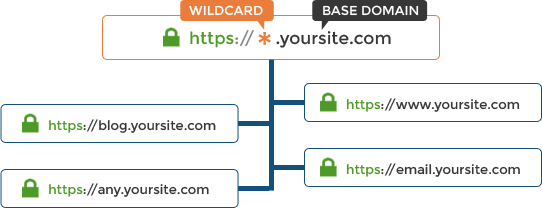
A Wildcard SSL certificate is a type of SSL/TLS certificate that secures a primary domain and all of its first-level subdomains. The “wildcard” aspect is denoted by an asterisk (*) placed at the beginning of the domain name in the certificate details, like *.yourdomain.com.
This single certificate can be applied to:
- www.yourdomain.com
- blog.yourdomain.com
- shop.yourdomain.com
- mail.yourdomain.com
- login.yourdomain.com
- And any other subdomain you create under yourdomain.com.
Without a wildcard certificate, you would need to purchase and install a separate SSL certificate for each of these subdomains. A Wildcard SSL streamlines this process, providing comprehensive encryption across your entire web presence with one certificate, one validation process, and one renewal date.
How Does a Wildcard SSL Certificate Work?
The functionality of a Wildcard SSL certificate is rooted in how Certificate Authorities (CAs) issue and browsers recognize them. When you apply for a wildcard certificate, you specify the domain name with an asterisk in the common name field of your Certificate Signing Request (CSR). For example, *.yourdomain.com.
When a user visits any of your subdomains (like shop.yourdomain.com), their browser initiates the SSL handshake. During this process, your server presents the Wildcard SSL certificate. The browser checks the certificate and sees that it was issued for *.yourdomain.com. The asterisk acts as a placeholder, matching any valid subdomain name at that level. As long as the certificate is valid, trusted, and correctly installed, the browser establishes a secure, encrypted connection.
It’s important to note that a standard Wildcard SSL certificate only covers subdomains at one level. For example, a certificate for *.yourdomain.com will secure blog.yourdomain.com but will not secure news.blog.yourdomain.com. This is a second-level subdomain and would require a separate certificate or a more advanced Multi-Domain Wildcard certificate.
The Key Benefits of Using a Wildcard SSL
Choosing a Wildcard SSL certificate offers several significant advantages, particularly for businesses and organizations with multiple web properties under a single domain.
1. Cost-Effectiveness
The most immediate benefit is financial. Purchasing individual SSL certificates for dozens of subdomains can become expensive very quickly. A single Wildcard SSL certificate almost always costs less than buying even a handful of separate certificates. This makes it an incredibly budget-friendly solution for securing a growing number of subdomains without a growing security bill.
2. Simplified Certificate Management
Imagine tracking the expiration dates, validation requirements, and installation processes for ten, twenty, or even fifty different SSL certificates. It’s a logistical nightmare that is prone to human error. A forgotten renewal can lead to security warnings that drive visitors away or even take a service offline.
A Wildcard SSL consolidates all your subdomain security under one umbrella. You only have one certificate to purchase, one validation to complete, and one renewal date to remember. This dramatically simplifies administration, saving you time and reducing the risk of a security lapse.
3. Fast Deployment for New Subdomains
With a Wildcard SSL in place, you can add new subdomains and secure them almost instantly. Once you create a new subdomain, like support.yourdomain.com, you can apply the existing wildcard certificate to it without needing to go through a new purchasing and validation process. This flexibility allows you to scale your web services quickly and securely, without waiting days for a new certificate to be issued.
.
Common Use Cases for a Wildcard SSL
The versatility of Wildcard SSL certificates makes them ideal for a variety of scenarios. Here are some common situations where they are the perfect fit:
- E-commerce Sites: Online stores often use subdomains for different functions, such as shop.yourstore.com, checkout.yourstore.com, and account.yourstore.com. A Wildcard SSL ensures all these critical touchpoints are secured.
- Business Websites: A company might have its main site at www.company.com, a blog at blog.company.com, a customer portal at clients.company.com, and an internal system at intranet.company.com.
- Web Hosting Providers: Hosting companies can use wildcard certificates to secure customer control panels or webmail services across thousands of accounts (e.g., cpanel.customerdomain.com).
- SaaS Platforms: Software-as-a-Service providers often give each customer a unique subdomain for their instance of the application (e.g., clientA.saas.com, clientB.saas.com). A Wildcard SSL is the only practical way to secure all these customer environments.
Choosing the Right Wildcard SSL: DV vs. OV
Just like standard SSL certificates, wildcards are available in different validation levels. The two main types are:
- Domain Validated (DV) Wildcard SSL: This is the most common and affordable option. The Certificate Authority only verifies that the applicant has control over the registered domain name. The validation process is typically automated and completed in minutes. DV wildcards are perfect for blogs, personal websites, and small businesses that need to secure multiple subdomains quickly.
- Organization Validated (OV) Wildcard SSL: This certificate offers a higher level of trust. The CA conducts a light vetting process to verify the legal existence and physical address of the organization applying for the certificate. This business information is included in the certificate details, providing visitors with extra assurance that they are dealing with a legitimate entity. OV wildcards are recommended for businesses, non-profits, and e-commerce sites where trust is a key conversion factor.
Note: Extended Validation (EV) certificates are not available in a wildcard format due to security guidelines set by the CA/Browser Forum.
In conclusion, the Wildcard SSL certificate is a smart, scalable, and secure solution for any organization managing multiple subdomains. By simplifying administration and reducing costs, it removes the barriers to comprehensive website security. It empowers you to protect your users’ data across your entire digital ecosystem, all while making your own life easier. If you’re running more than just a single domain, a Wildcard SSL is not just a convenience—it’s a necessity.