


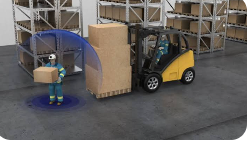
Walk into a sprawling logistics depot or cross-dock terminal during peak operating hours, and the surface level appears entirely productive. Dozens of material handling vehicles speed down transit lanes; engines hum, and operators actively move pallets between storage racks and outbound staging grids. Look closer at the movement patterns, however, and you will uncover a quiet layout efficiency drainage system.
Forklift operators regularly travel the entire length of a facility completely empty, entirely unaware that a high-priority shipment was ready for pickup just a few paces from their previous drop-off point.
Traditional logistical frameworks run on a transactional delay that causes this exact issue. Your central warehouse inventory management platform logs exactly when a pallet is scanned at a storage rack and when it eventually arrives at a trailer dock. However, it lacks any method to see the physical paths your vehicles take between those destination points. When dispatch software operates completely blind to the live positions of the active fleet, assignments get handed out based on rigid, sequential lists rather than immediate floor proximity.
Deploying industrial Real-Time Forklift Tracking bridges this information gap by supplying a continuous coordinate stream straight into your routing logic. Instead of forcing drivers to walk or drive out of their way to check staging monitors, dispatch managers to capture an automated view of their equipment. This structural upgrade turns standard warehouse confusion into an orchestrated layout that matches tasks to the nearest idling machine.
Stopping Profit Leak of Empty Fleet Travel
The primary margin killer inside heavy transit environments is not an equipment bottleneck; it is an asset utilization failure known on the floor as deadheading. Without continuous spatial location coordinates, material handling vehicles spend a significant portion of their active shift times traveling without a payload. Drivers complete a drop-off assignment and drive back to a main desk simply because the central database does not realize they are parked right next to a waiting shipment.
Implementing live fleet mapping updates your system continuously, letting you orchestrate your vehicle travel patterns based on absolute proximity.
- Proximity task grouping: Automate your routing so that when an operator completes a storage run, the software instantly hands them up a nearby outbound pick task, minimizing empty travel miles.
- Aisle bottleneck detection: Identify real-time vehicle clustering in narrow storage corridors, allowing dispatchers to dynamically reroute inbound trucks to clear traffic lanes before congestion stops production.
- Granular turn times: Monitor exactly how many minutes a driver spends idling inside a trailer bed versus moving across the main floor, isolating hidden delays during loading cycles.
By pairing live location infrastructure with smart task assignment queues, you stop burning machine runtimes and fuel on empty mileage. This shift drastically lowers your daily equipment depreciation costs while driving up your total shipments handled per shift.
Optimizing Fleet Scale and Reducing Capital Expenditures
When logistics directors lack objective data detailing how their material handling fleets move, they tend to over-correct by leasing extra machinery to keep up with peak cycles. If a specific department experiences material transit delays, the standard corporate response is to request additional trucks or reach units to appease floor management.
This approach inflates your fleet to lease overhead while leaving the real structural workflow bottlenecks completely untouched. Continuous fleet visibility reveals the objective truth behind equipment utilization, exposing which machines are genuinely handling loads versus which ones sit parked in unmapped corners or are hoarded by specific shifts to safeguard local targets.
Isolating these hidden or underutilized units’ gives you the concrete data needed to right-size your entire fleet footprint. You gain the leverage to confidently return excess equipment when lease terms expire, running a much tighter operation without dropping your daily shipping volume. Furthermore, you can link distance-traveled metrics directly to maintenance alerts, servicing your trucks based on exact mechanical wear rather than arbitrary calendar dates.
Ending Signal Barriers Without Vendor Lock-In
A major challenge when rolling out large-scale tracking projects is engineering around the hostile physics of a fulfillment warehouse. High-density steel storage racks, stacked metallic pallets, and moving overhead infrastructure create an aggressive environment that easily deflects and absorbs standard wireless signals.
Overcoming these physical barriers requires a highly strategic layout design, but it should never require getting trapped in a closed, single-vendor hardware monopoly. Many tracking providers lock their management platforms to their own expensive, proprietary active tags, making it financially impossible to scale across multiple distribution centers.
Building a future-proof tracking network demands a technology-agnostic architecture at your data layer. A tight cross-dock cell handling specialized high-value inventory might require the sub-inch precision of Ultra-Wideband anchors, while your standard bulk storage lanes or outdoor trailer yards can run efficiently on Bluetooth Low Energy or standard Wi-Fi setups. Unifying these varied hardware streams through an open framework keeps your upfront infrastructure costs manageable while ensuring your tracking network can scale naturally as your logistics footprint grows.
Lesser Uncertainty and Better Fleet Safety with LocaXion
LocaXion is the world’s first pure-play RTLS and Digital Twin systems integrator. We engineer systems for your business outcomes, not just tracking.
That means less risk, less integration of guesswork, and faster time-to-value. Because we are not locked to one technology stack, you get the freedom to scale with the right technology, not the technology we happen to sell.
Real-time forklift tracking locates your fleet. LocaXion transforms how your warehouse runs.
That is the difference. And it is not a small one.
Stop wasting margins on empty vehicle travel and engineer your outcomes today.