


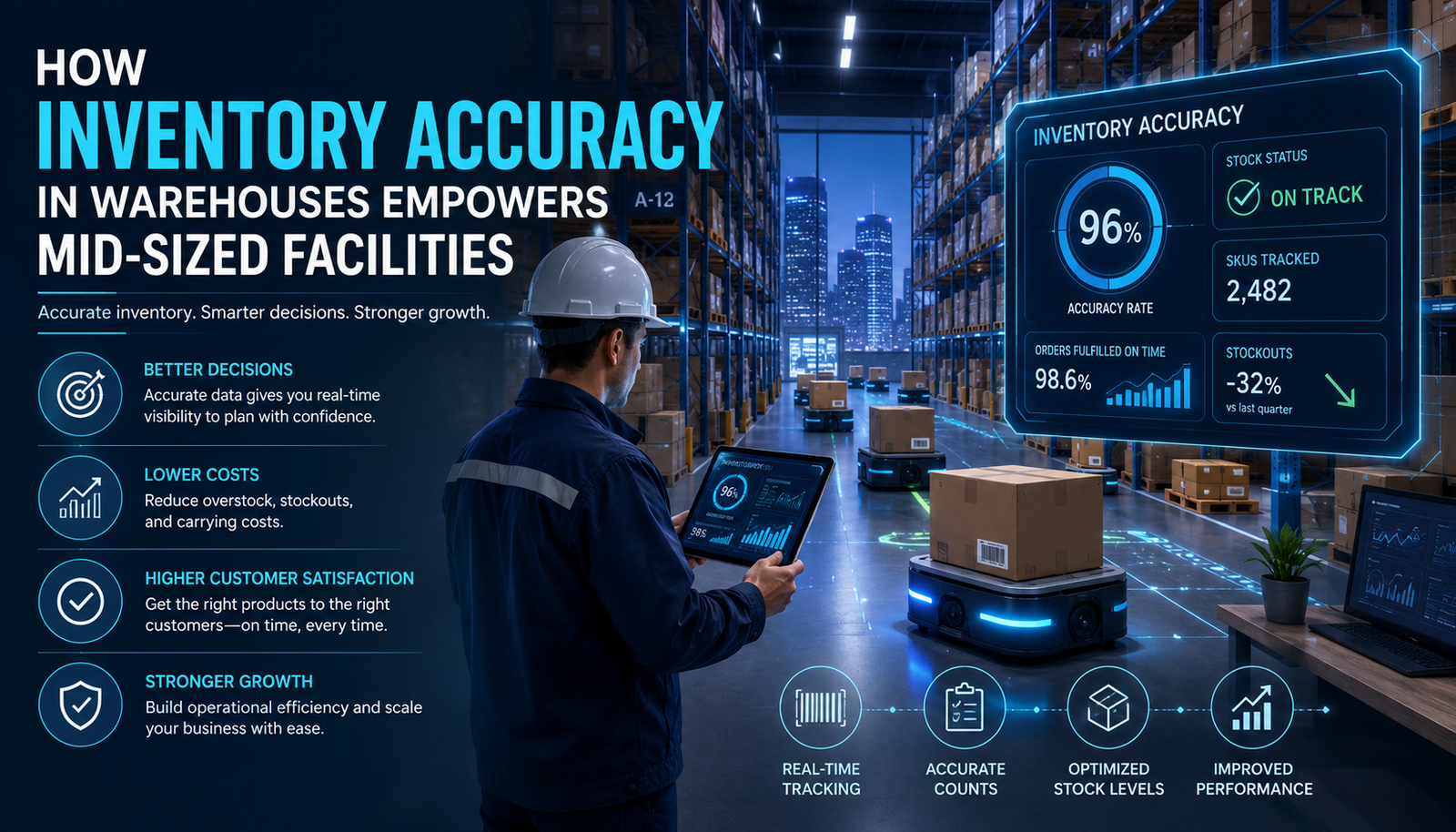
Imagine asking a warehouse operations manager a simple question: “Does your system actually match your shelves?” More often than not, the response is a stressed laugh followed by stories of phantom stockouts, missing pallets, and midnight reconciliation sessions.
Inventory discrepancy is the quiet tax on mid-sized logistics. These businesses have outgrown the manual simplicity of small operations, yet they lack the multi-million-dollar automation budgets of retail giants. Caught in this middle tier, they handle enterprise-level multi-channel complexity using restricted resources.
When system records diverge from physical reality, the damage hits the bottom line immediately. Delayed deliveries, forced buffer stock, and spiraling labor costs quickly turn minor administrative mismatches into a critical drain on profitability. Fixing this data gap is no longer just an operational goal; maintaining precise inventory accuracy in warehouses is a basic requirement for staying competitive.
Why Warehouse Inventory Management Has Become a Growing Challenge
Ten years ago, a warehouse managing a few hundred SKUs and two or three sales channels could stay organized with a decent spreadsheet and an experienced staff who knew the floor layout. That world is gone.
Today, the same facility might carry thousands of SKUs and fulfill orders across an owned website, Amazon, TikTok Shop, wholesale accounts, and brick-and-mortar retail, all while dealing with customers who expect rapid delivery as a baseline.
Modern warehouse inventory management has had to evolve rapidly. The problem is that legacy systems, internal processes, and budgets haven’t kept pace.
- Skyrocketing SKU Counts: More product variations mean more room for placement errors.
- Omnichannel Friction: The exact same physical item might be promised to three different digital sales channels simultaneously.
- Tighter Delivery Windows: Zero-tolerance shipping schedules leave no room to catch and correct errors before a truck pulls away from the dock.
- Floor Complexity: Multiple storage zones, dynamic slotting, cross-docking, and high-volume returns processing mean there are more places for things to go missing at any given moment.
Inventory visibility suffers most in these high-pressure conditions. When you fail to prioritize warehouse inventory management, every other part of the fulfillment chain degrades. Picking errors rise, replenishment decisions are made on bad data, and customer-facing teams confidently promise stock that doesn’t actually exist.
The Biggest Causes of Inventory Discrepancies
Understanding why inventory accuracy in warehouses degrades starts with knowing exactly where the floor operation breaks down. In most mid-sized facilities, it happens in the same vulnerable places over and over.
Manual Data Entry Errors
When a tired dock worker receives a pallet of 240 units at 4:30 PM and accidentally types “204” into the system, that mistake lives in your records until someone manually catches it. Manual data entry is slow, tedious, and highly vulnerable to human error. The more transactions a facility processes a day, the more these micro-mistakes stack up against your overall inventory accuracy in warehouses.
Inefficient Receiving Processes
The receiving dock is where inventory discrepancies are born. It is the classic logistics rule of “garbage in, garbage out.” Shipments arrive incomplete, miscounted, or damaged, and teams under pressure move fast to keep the staging areas clear. Without a strict, standardized verification process to check incoming quantities against purchase orders immediately, poor warehouse inventory management allows discrepancies to enter your software before the product even touches a storage rack.
Legacy Software and Systems
Many mid-sized facilities still rely on tracking tools that were never built for the volume or complexity they handle today. Disconnected spreadsheets, basic point-of-sale tools, or legacy software pressed into heavy-duty tracking fail to give operations managers a live, unified picture. Without real-time data, baseline inventory accuracy in warehouses begins to slip.
Misplaced Inventory and Picking Errors
A product placed in the wrong bin doesn’t disappear; it just becomes entirely invisible to the system. It stays lost until someone stumbles across it while looking for something else. Picking errors compound this. When the wrong item ships, you are suddenly dealing with a customer complaint, a return log, an emergency reshipment, and a brand-new stock discrepancy all at once. One small picking mistake creates a costly chain reaction that undermines your broader goals for warehouse inventory management.
The Hidden Cost of Mismanagement
The obvious cost of failing to protect inventory accuracy in warehouses is a missed sale or a late delivery. But the full financial damage runs much deeper.
Think about what happens when records are off: your team spends expensive, paid labor hours searching for a product that the system claims is there but can’t be found. Orders get delayed while someone physically walks the aisles trying to locate stock, and emergency replenishment orders go out, often at premium shipping rates, to cover gaps that better warehouse inventory management would have prevented.
Then there is the issue of excess inventory. Small and mid-sized businesses hold an average of $142,000 worth of inventory above what they actually need. A significant portion of this excess exists because poor data visibility forces teams to order conservatively, buying expensive “buffer stock” to compensate for a system they don’t fully trust.
Customer churn is the cost that stings the longest. Research consistently shows that when a customer experiences a stockout or receives the wrong item, the majority will not give the business a second chance; they simply find another supplier. In B2B logistics, poor inventory accuracy in warehouses can break hard-earned vendor relationships in a single botched order.
How Mid-Sized Facilities Are Fixing the Gap
Mid-sized warehouses are increasingly turning to structured operational improvements rather than expensive full automation.
- Cycle counting reduces reliance on disruptive annual audits
- Barcode scanning eliminates manual entry errors
- RFID tracking improves real-time visibility
- Warehouse Management Systems (WMS) unify inventory data across channels
Many facilities are also partnering with technology providers such as Unique Software Development to implement customized warehouse inventory management solutions that connect operations, improve data accuracy, and reduce system-to-floor mismatches without requiring enterprise-level budgets.
Alongside technology adoption, employee training remains essential to ensure that tools are used consistently and correctly across daily workflows.
The Bottom Line
Maintaining high inventory accuracy in warehouses is no longer just an administrative checkbox. It is a direct driver of corporate revenue, customer retention, and long-term market competitiveness.
Mid-sized logistics operations that close their data accuracy gaps gain an immediate edge: leaner inventory levels, faster fulfillment, fewer costly returns, and high customer retention. Those that ignore comprehensive warehouse inventory management will continue to absorb hidden labor and shipping costs that quietly eat away at profit margins.
With the right combination of cycle counting, barcode discipline, modern WMS tools, and strategic software partners like Unique Software Development company, warehouses can move from reactive firefighting to predictable, scalable operations.