


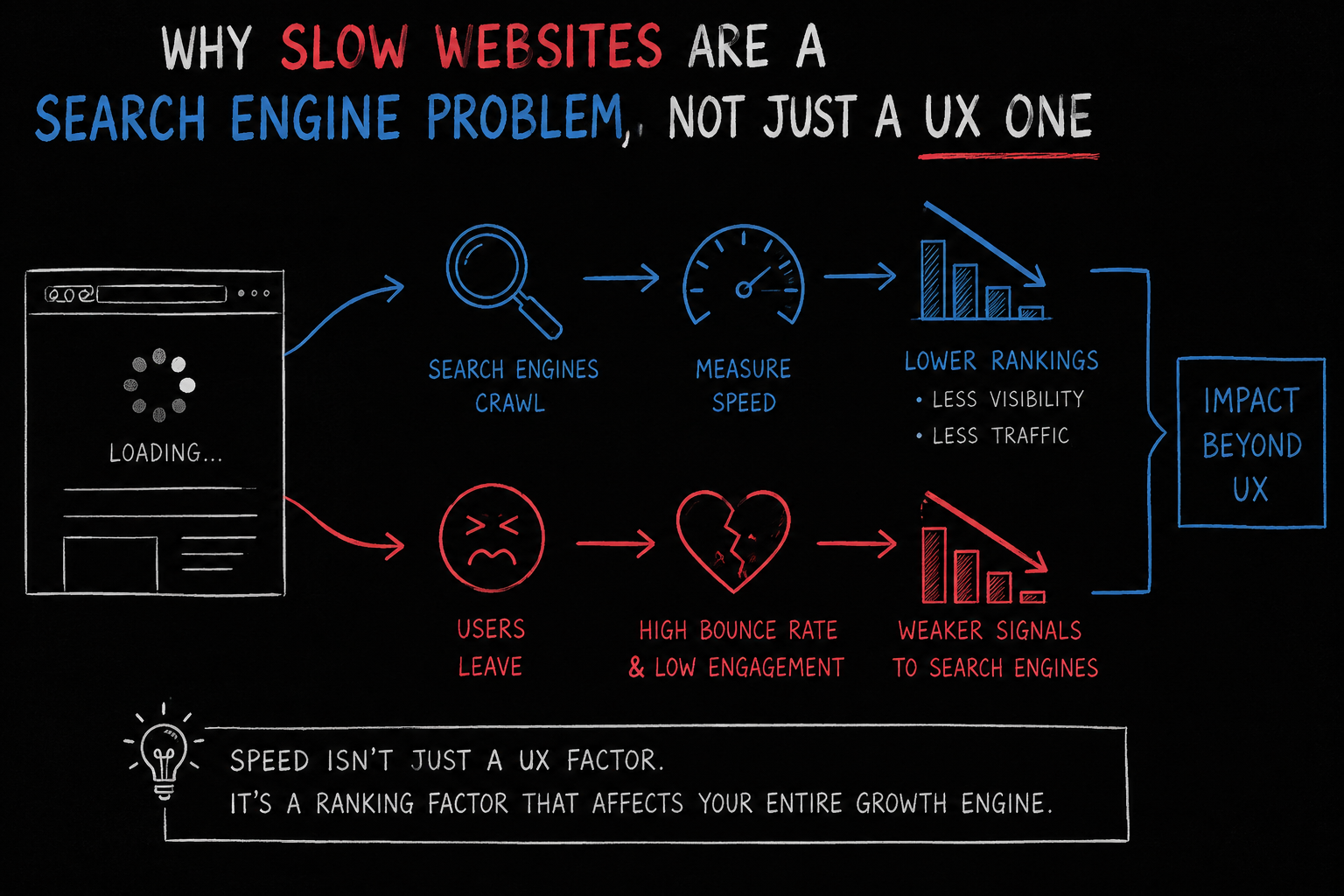
There is a widely held assumption that SEO is primarily a content discipline. Get your keywords right, write enough articles, earn some links, and the rankings will follow. That is still broadly true, but it misses something that has quietly become just as important: how your website actually performs when someone lands on it. Google has been nudging webmasters in this direction for years. The Core Web Vitals update made it explicit. Search engines now factor in load speed, visual stability, and responsiveness as ranking signals. In practice, that means a poorly performing website is fighting an uphill battle regardless of how good its content is.
What Google Is Actually Measuring
Core Web Vitals breaks down into three signals that are worth understanding properly. Largest Contentful Paint (LCP) measures how quickly the main content of a page loads. A score under 2.5 seconds is considered good. Above 4 seconds and you are almost certainly losing both visitors and ranking potential. Interaction to Next Paint (INP) replaced First Input Delay in 2024 and measures how quickly a page responds when someone interacts with it. Clicking a menu item or submitting a form and waiting half a second for something to happen is a bad score. Cumulative Layout Shift (CLS) tracks whether elements on your page jump around as it loads. Images that push text down, buttons that move before you click them, banners that pop in late. All of this contributes to a poor CLS score.
| Metric | What It Measures | Good | Needs Work | Poor |
| LCP | Main content load speed | Under 2.5s | 2.5s to 4s | Over 4s |
| INP | Response to user input | Under 200ms | 200ms to 500ms | Over 500ms |
| CLS | Visual stability on load | Under 0.1 | 0.1 to 0.25 | Over 0.25 |
None of these are arbitrary hoops. They are measuring things real users genuinely notice. The reason they matter for SEO is that Google treats poor user experience as a signal that a page is not worth promoting.
The Technical Overlap Nobody Explains Clearly
What makes this worth paying attention to is how much the work of improving performance overlaps with the work of improving search visibility. Serving images in modern formats, cleaning up render-blocking scripts, improving server response times, using a content delivery network, tidying up your URL structure: all of these things make your site faster for visitors. They also make it easier for search engine crawlers to get through your pages efficiently. When a crawler has to wait for a bloated script to finish executing before it can parse your page content, that is wasted crawl budget. When your pages load in under a second, crawlers move through your site cleanly and your content gets indexed faster. The distinction between “technical SEO” and “site performance” is largely artificial. In practice they are the same body of work, and businesses that treat them as separate functions tend to underperform at both.
How This Plays Out in Practice
Think about local search. When someone searches for cocktail bars in Deansgate or a co-working space in Spinningfields, Google is not just matching keywords to content. It is also evaluating which of the results it can confidently serve. A bar with a fast, mobile-friendly site that loads cleanly over 4G is going to have a structural advantage over a competitor with better reviews but a site that takes six seconds to show a menu. This matters especially on mobile, where most local searches happen. Google uses mobile-first indexing, which means the mobile version of your site is what gets evaluated and ranked, not the desktop version. If your mobile experience is an afterthought, that shows up in your rankings. The same principle applies across sectors. An accountancy firm, a property developer, a software company: any business that relies on organic search to generate enquiries is competing not just on content but on how well its website holds up when people actually use it. Working with search specialists who understand both the technical and strategic side means those two workstreams get planned together rather than bolted together after the fact.
Where Most Businesses Get Stuck
The performance and SEO conversation tends to get complicated because the two disciplines have historically sat in different departments. Developers own site speed. Marketers own keywords and content. Neither group is necessarily watching how their decisions affect the other. The result is often a site that looks fine in isolation but has problems that compound. A marketing team adds a third-party tracking script that slows down the page. A development team updates the CMS and breaks a canonical tag. Nobody notices because nobody owns the full picture. Businesses that perform well in organic search over time tend to be the ones that have joined those two workstreams up, either internally or through an external team that covers both. The technical side and the search strategy side need to inform each other from the start, not be reconciled after the fact.
A Practical Starting Point
If you want to understand where your site sits before spending money on anything, PageSpeed Insights (free, from Google) will give you a Core Web Vitals score for both mobile and desktop and flag the specific issues causing problems. Images are usually the biggest quick win. Uncompressed images and outdated formats like PNG for photography add significant load time. Switching to WebP and compressing properly is often the single biggest performance improvement for sites that have not done it. Third-party scripts are the second common culprit. Chat widgets, analytics platforms, marketing tags: each one adds a request and most of them block rendering. Auditing what is actually necessary and loading non-critical scripts asynchronously can make a measurable difference. Hosting and server response is worth checking if your time to first byte is consistently above 600ms. Shared hosting that made sense when the site launched often becomes a bottleneck as traffic grows. Mobile usability should be checked separately from desktop. Google Search Console has a dedicated mobile usability report that flags things like text that is too small to read, clickable elements that are too close together, and content wider than the screen. None of this requires a rebuild. Most of it is incremental improvement to what already exists.
The Bigger Picture
The businesses that perform well in search over a sustained period are rarely the ones that had a single breakthrough moment. They are the ones that have kept the fundamentals in reasonable shape and improved consistently over time. Performance is one of those fundamentals. Not because it is glamorous, but because it directly affects whether people stay on your pages, whether Google trusts your site, and whether the content you invest in actually gets seen. If your site is slow, fix that first. Everything else becomes more effective when the foundation is solid.