


The crypto industry has rapidly evolved from a single-chain environment into a multi-chain ecosystem. Users, liquidity, and communities are now spread across networks like Ethereum, Solana, BNB Chain, Base, and TON. As a result, the tools used to launch tokens are also changing. One of the most significant shifts is the rise of multi-chain launchpad, which are gradually replacing traditional single-chain platforms such as Pump.fun.
The Limitations of Single-Chain Launchpads
Single-chain launchpads were essential in the early growth of the memecoin and token economy. Platforms like Pump.fun made it incredibly easy for users to create tokens with minimal technical knowledge. This simplicity drove massive adoption and lowered the barrier to entry.
However, this model comes with clear limitations.
First, single-chain platforms restrict projects to one ecosystem. If a token launches on Solana, for example, it primarily reaches Solana users. This limits exposure to broader audiences on other chains like Ethereum or BNB Chain.
Second, liquidity is confined. Each blockchain has its own liquidity pools, and being limited to one network reduces the ability to access capital from other ecosystems.
Third, growth becomes fragmented. Expanding beyond a single chain often requires additional tools, bridges, or even relaunching on another network—adding complexity and friction.
As the crypto market matures, these limitations are becoming harder to ignore.
The Rise of Multi-Chain Launchpads
Multi-chain launchpads are designed to solve these challenges. Instead of locking users into one blockchain, they enable token creation and interaction across multiple networks from a single platform.
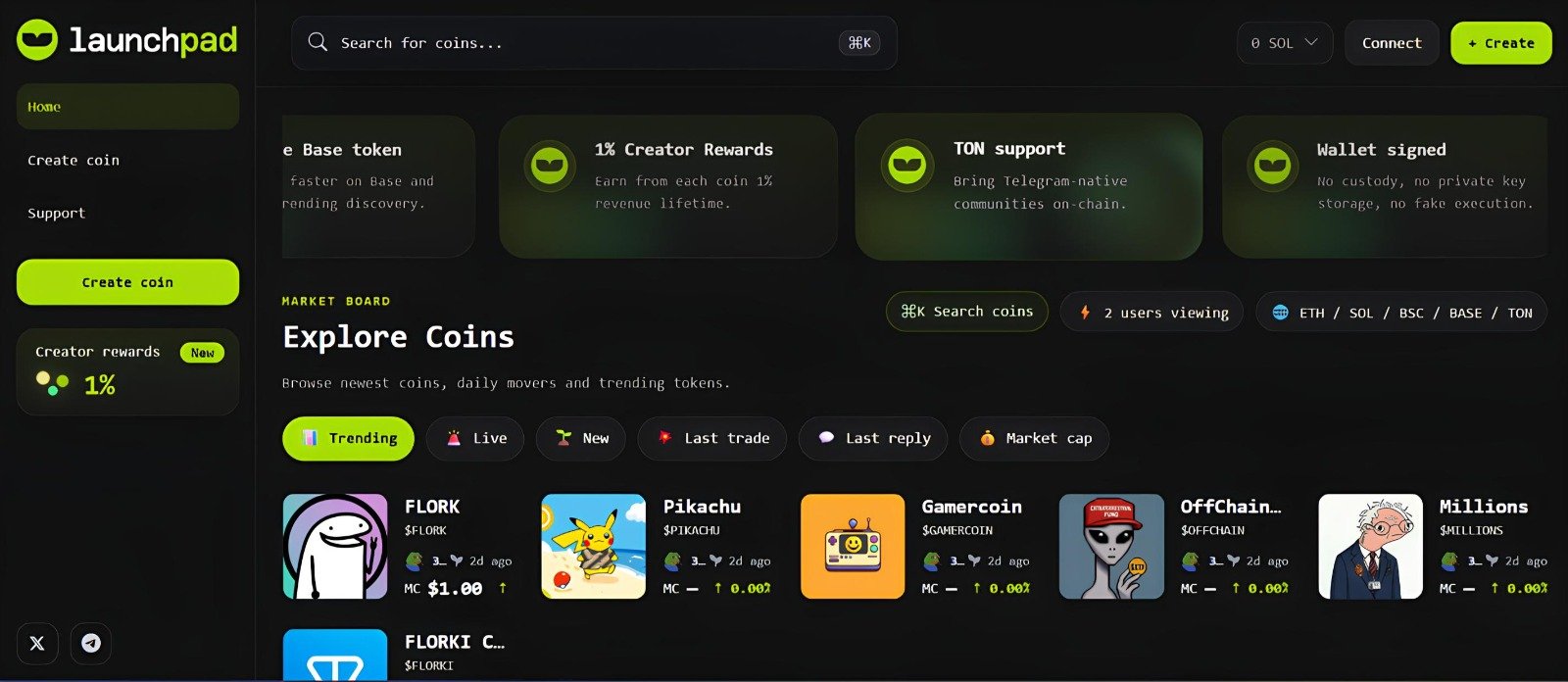
A strong example of this model is Launchpad.meme, which supports Ethereum, Solana, BNB Chain, Base, and TON. This approach allows creators to meet their audience wherever they are, rather than forcing users into a single ecosystem.
The shift toward multi-chain infrastructure reflects how crypto users actually behave today—moving fluidly between networks depending on cost, speed, and opportunity.
Key Advantages of Multi-Chain Platforms
1. Broader Audience Reach
Multi-chain launchpads allow projects to access users across different ecosystems. This significantly increases visibility and potential adoption. Instead of being limited to one community, tokens can attract participants from multiple networks simultaneously.
2. Expanded Liquidity Access
Liquidity is one of the most important factors in a token’s success. Multi-chain platforms provide access to different liquidity pools, improving trading activity and price stability. This reduces reliance on a single market and creates more opportunities for growth.
3. Faster and More Flexible Growth
Projects can scale more efficiently when they are not restricted to one blockchain. Multi-chain launchpads make it easier to expand, experiment, and adapt to market trends without starting from scratch.
4. Reduced Dependency Risk
Relying on a single blockchain can be risky. Network congestion, high fees, or ecosystem-specific downturns can impact a project’s performance. Multi-chain platforms reduce this dependency by spreading exposure across multiple networks.
Beyond Launching: The Ecosystem Advantage
Another major shift is that modern launchpads are no longer just about token creation. Multi-chain platforms are evolving into complete ecosystems.
For example, Launchpad.meme integrates:
- Token creation
- Trading interfaces
- Real-time activity tracking
- Discovery tools such as leaderboards
This all-in-one approach eliminates the need for external platforms and simplifies the user experience.
In contrast, many single-chain launchpads focus primarily on deployment, leaving users to rely on third-party tools for trading and analytics.
The Role of Emerging Ecosystems
Multi-chain platforms also unlock access to emerging ecosystems that are growing rapidly. One notable example is TON, which connects directly with Telegram communities.
By supporting TON, platforms like Launchpad.meme enable creators to tap into highly engaged social networks, creating new opportunities for viral growth and community-driven adoption.
This kind of integration is difficult to achieve within a single-chain framework.
The Future of Token Launching
The shift from single-chain to multi-chain launchpads is not just a trend—it reflects a fundamental change in how crypto operates.
As users continue to diversify across networks, platforms that offer flexibility, scalability, and broader access will have a clear advantage. Multi-chain launchpads align with this reality, making them better suited for long-term growth.
Conclusion
Single-chain platforms like Pump.fun played a crucial role in making token creation accessible. However, as the crypto ecosystem expands, their limitations are becoming more apparent.
Multi-chain launchpads provide a more advanced solution by enabling cross-chain access, improving liquidity, and offering integrated tools for both creators and traders.
Platforms like Launchpad.meme demonstrate how this model can work in practice, combining multi-chain functionality with a complete ecosystem for launching and trading tokens.
As the industry continues to evolve, multi-chain launchpads are likely to become the standard, replacing single-chain platforms and shaping the next generation of crypto innovation.