

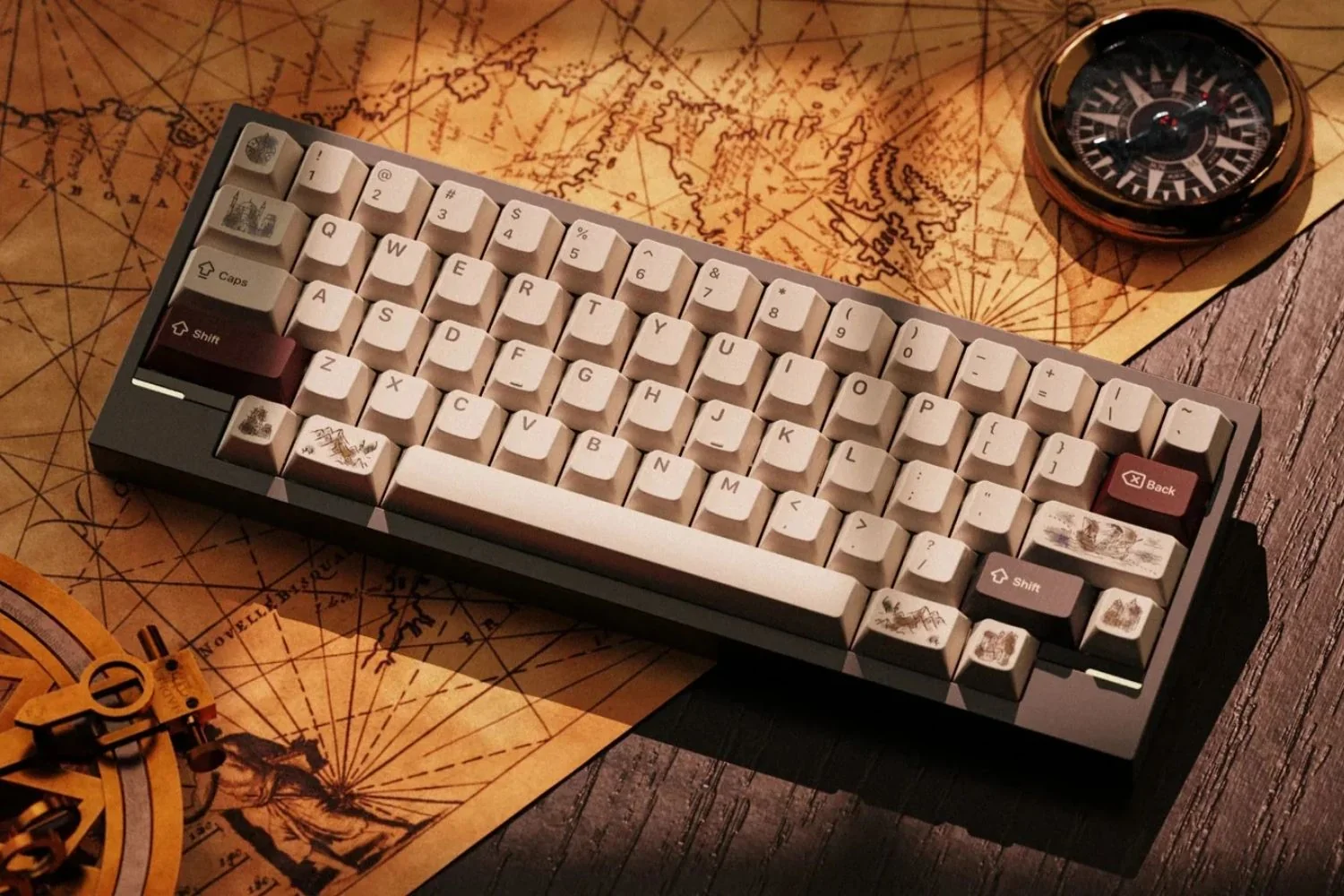
If you have ever looked at a mechanical keyboard and wondered why two keyboards with the same switches can feel and sound completely different, the answer may be sitting right under your fingertips: the keycaps.
A keyboard keycap is more than a plastic cover placed over a switch. Its material, thickness, shape, profile, surface texture, and legend design can all influence how a keyboard feels during typing and how it looks on your desk.
For someone building a custom mechanical keyboard, replacing keycaps can also be one of the easiest ways to personalize an existing board without replacing the switches, PCB, or case.
But choosing keycaps is not simply a matter of picking your favorite color. Compatibility, keyboard layout, keycap profile, material, and manufacturing method all matter.
This guide explains the fundamentals of keyboard keycaps and provides a practical way to choose a set based on how you actually use your keyboard.
What Is a Keyboard Keycap?
A keyboard keycap is the removable top piece that sits above a keyboard switch. When you press a key, the keycap transfers your finger’s movement to the switch stem underneath, allowing the switch to register the keystroke.
On a mechanical keyboard, the keycap normally attaches to the switch through a stem. Many modern mechanical keyboards use the familiar cross-shaped MX-style stem, although other mounting systems also exist.
Keycaps also determine much of what your fingers actually touch. The top surface may be smooth, textured, flat, cylindrical, or spherical, while the sides and overall height vary between profiles.
The letters, numbers, symbols, and icons printed or molded into a keycap are called legends.
For everyday users, keycaps primarily affect appearance and typing feel. For mechanical keyboard enthusiasts, they are also an important part of customization because changing the keycaps can significantly alter the character of an existing keyboard.
How Does a Keycap Work on a Mechanical Keyboard?
When you press a key, your finger pushes the keycap downward. The keycap’s stem transfers that movement to the switch beneath it.
The switch then moves according to its design—linear, tactile, or clicky—and sends an electrical signal to the keyboard’s controller.
The keycap itself does not determine the switch’s actuation point, but its weight, shape, height, and material can influence the overall typing experience and sound.
This is why two keyboards using the same switches can still feel noticeably different after changing their keycaps.
What Are the Different Types of Keyboard Keycaps?
There are several ways to classify a keyboard keycap, including material, manufacturing method, profile, and design.
The two plastic materials you will encounter most often are ABS and PBT. Other options include metal, ceramic, resin, and specialty materials, although these are less common for everyday full-size keycap sets.
For most buyers, ABS and PBT are the most practical starting point.
The manufacturing method is another important distinction. Double-shot and dye-sublimated keycaps are two common ways of producing legends, and each has different characteristics.
The right choice depends on your priorities. A programmer who types for several hours every day may care more about surface texture and long-term appearance, while a gamer may prioritize consistent key sizes, RGB compatibility, and a particular profile.
| Keycap Type | Typical Characteristics | Often Suited To |
| ABS | Smooth feel, vivid colors, generally lighter | Gaming, colorful builds, users who prefer smooth surfaces |
| PBT | More textured feel, good resistance to visible shine | Everyday typing, office use, enthusiasts |
| Double-shot | Legends are formed from separate molded plastic | Users prioritizing durable legends |
| Dye-sublimated | Legend ink is transferred into the keycap material | Detailed designs and PBT keycaps |
| Metal | Dense, distinctive feel and appearance | Specialty/custom builds |
| Resin | Often used for decorative artisan designs | Custom keyboard enthusiasts |
These categories can overlap. For example, a keycap can be both PBT and double-shot, or PBT and dye-sublimated.
What Is the Difference Between ABS and PBT Keycaps?
ABS stands for acrylonitrile butadiene styrene, while PBT stands for polybutylene terephthalate.
ABS is widely used for original equipment keycaps because it is relatively easy to manufacture and can produce bright colors and a smooth surface. With frequent use, however, ABS surfaces can develop a visible glossy appearance, commonly called “shine.” WIRED notes that this can be either a drawback or simply part of the character of a well-used keyboard.
PBT is commonly associated with a more textured surface and greater resistance to visible shine. Many aftermarket keycap sets therefore use PBT, particularly for users who want a slightly more tactile surface during long typing sessions.
Neither material is automatically better for everyone.
If you prefer a smooth, slick surface and vibrant colors, ABS may be appealing. If you prefer texture and want the keycaps to retain their original appearance for longer, PBT may be a better starting point.
In practice, PBT and ABS each have their own advantages, and neither is simply better. High-end keycap sets are usually ABS double-shot, because ABS takes color extremely well — allowing brighter, more accurate colors — and double-shot legends never wear off. PBT, by contrast, is prized for longevity, a deeper, thockier sound profile, and lower production cost when made with dye-sublimation. You can browse both at UniKeys: ABS double-shot keycaps and PBT dye-sub keycaps.
What Are Double-Shot and Dye-Sublimated Keycaps?
Double-shot and dye-sublimation describe how the legends are made, rather than the material itself.
With double-shot keycaps, two separate plastic pieces are molded together. One forms the keycap body and the other forms the legend. Because the legend is part of the molded structure, it is not simply a layer of ink sitting on the surface.
This process can produce sharp, durable legends and is available with both ABS and PBT keycaps today.
Dye sublimation works differently. A dye is transferred into the keycap material under controlled heat and pressure. It is especially common with PBT keycaps and allows manufacturers to create detailed legends and decorative designs.
For example, if you want a retro-style keyboard with detailed graphics or unusual fonts, dye-sublimated PBT sets can offer a wide range of design possibilities.
If your priority is highly durable legends, double-shot is worth considering. If you want detailed artwork or a broad range of printed designs, dye sublimation may be more attractive.
For the best ABS double-shot sets, GMK and KeyKoBo remain the benchmark. Their molds are highly precise, they use good-quality ABS, and their mature double-shot injection process delivers consistent, accurate coloring, crisp legends, and clean tolerances.
For PBT dye-sublimated sets, Monster Lab and TUT are excellent choices. They use good PBT material with a high PBT content and a mature dye-sub process that keeps colors accurate and legends sharp — without the smudging or fuzzy legends common on cheaper PBT keycaps.
What Are Keycap Profiles and Sizes?
Keycap profile describes the height and shape of the keycap. It has a noticeable effect on how your fingers move between rows.
Some profiles are sculpted, meaning different rows have different heights and angles. Others are uniform, meaning the keys share a similar shape and height.
Common profiles include Cherry, OEM, SA, XDA, and DSA, although manufacturers may also create their own variations.
There is an important detail for beginners: keycap profile names are not always standardized across the industry. WIRED also points out that manufacturers can use different naming conventions, so checking the actual dimensions and compatibility information is useful when comparing sets.
What Are the Most Common Keycap Profiles?
OEM profile is common on prebuilt mechanical keyboards. It generally has a sculpted shape and is familiar to many users.
Cherry profile is shorter than OEM and is widely used in aftermarket mechanical keyboard sets. It has a sculpted shape that many typists find familiar.
SA profile is significantly taller and has a more pronounced sculpted shape. It can create a distinctive appearance and deeper sound, but some users may prefer a wrist rest because of the additional height.
XDA is generally known for a more uniform profile with a relatively wide typing surface.
DSA is another relatively uniform profile and can be useful for people who prefer a consistent key shape across rows.
There is no universally best keycap profile. Your hand position, typing style, keyboard angle, and personal preference all matter.
How Do Keycap Sizes and Keyboard Layouts Affect Compatibility?
Before buying a keyboard keycap set, check both the switch stem and the keyboard layout.
A set designed for MX-style switches may not fit keyboards using different mounting systems. WIRED specifically identifies Alps, Topre/EC, and Kailh Choc as examples of systems that require different keycaps.
Layout is equally important.
A 60% keyboard, for example, removes the dedicated function row, navigation cluster, and number pad found on a traditional full-size keyboard. A 65% keyboard adds some navigation keys, while a 75% keyboard usually retains a function row in a more compact arrangement.
Even when the number of keys seems similar, special keys such as the Shift, Enter, Ctrl, Alt, and spacebar can have different widths.
ANSI and ISO layouts can also differ in key arrangement and dimensions. The current ISO/IEC 9995-1 standard describes keyboard sections, key spacing, physical characteristics, and the placement of characters and symbols on keys.
In practice, always check the keycap set’s supported layouts before purchasing.
How Do You Choose the Best Keyboard Keycaps?
There is no single “best” keyboard keycap for every user.
Instead, start with how you use your keyboard.
If you spend most of your day writing documents or coding, surface texture and profile may matter more than decorative features. If you primarily play games, you may care about key consistency, profile height, RGB shine-through, and the position of frequently used keys.
If you are building a keyboard for your home office, aesthetics may be just as important as typing feel.
For example, imagine a developer who types eight hours a day. A textured PBT set with a comfortable medium-height profile may be more appealing than an extremely tall profile. A gamer who frequently plays at night may instead prefer keycaps with shine-through legends so the keyboard’s backlighting remains visible.
Ergonomics should also be considered as part of the complete setup. The U.S. Occupational Safety and Health Administration recommends positioning a keyboard so that the wrists remain relatively straight and the shoulders remain relaxed. Keycap height alone cannot guarantee good ergonomics, but changing the profile can change the overall height and angle of the keyboard, so it is worth considering alongside desk and chair positioning.
What Should You Consider When Buying Keycaps?
Before ordering a new keycap set, work through this checklist:
1. Check switch compatibility
Look at the switch stem underneath your current keycap. MX-style cross stems are common, but they are not universal.
2. Check the keyboard layout
Confirm whether your keyboard is ANSI, ISO, or another layout. Then check whether the keycap set supports your specific keyboard size.
3. Choose a profile
Think about whether you prefer a lower, medium, or taller typing surface. Cherry and OEM are useful starting points for many users, while SA and other high-profile options create a different feel.
4. Choose the material
PBT is a popular choice for users who prefer texture and resistance to visible shine. ABS may be preferable if you like smoother surfaces and vivid colors.
5. Check the legend method
Double-shot legends are molded into the keycap, while dye-sublimated legends are transferred into the material. If RGB lighting is important, also confirm whether the legends are designed for shine-through.
6. Check the included keys
Do not assume a “full set” includes every key you need. Some modern sets separate number pads, alternative modifiers, or specialty keys into different kits.
Are Custom Keycaps Worth It?
Custom keycaps can be worthwhile if you want to change the appearance or typing feel of an existing mechanical keyboard without replacing the entire board.
They can also make a relatively ordinary keyboard feel more personal.
For example, a programmer might choose a neutral PBT set with subtle accent keys, while a gamer may choose a high-contrast colorway with shine-through legends. Someone building a retro-themed setup could choose dye-sublimated keycaps with vintage colors and typography.
The cost can range from relatively inexpensive mass-produced sets to much more expensive limited-edition or artisan keycaps.
You can browse different styles and configurations in our Keyboard Keycap collection if you want to compare available options.
However, customization does not automatically mean better performance. If your current keycaps already fit comfortably and meet your needs, replacing them may mainly be an aesthetic upgrade.
For many users, that is still a worthwhile reason.
Recommended Keycap Brands at UniKeys
If you are not sure where to start, our best-selling keycap brands are a safe bet. For ABS double-shot, GMK and KeyKoBo lead on color accuracy and legend quality. For PBT dye-sub, Monster Lab and TUT offer excellent material with clean, long-lasting legends. You can explore the full range in our keycaps collection.
Conclusion
A keyboard keycap is a small component, but it plays a surprisingly large role in the overall keyboard experience.
Material affects surface texture and long-term appearance. Manufacturing methods influence legend durability and design possibilities. Profile changes the shape and height under your fingers, while keyboard layout determines whether the set will actually fit.
For most buyers, the easiest approach is to check compatibility first, then choose material and profile based on how you use your keyboard.
If you are still unsure, a medium-height PBT set with a common profile and broad layout support can be a practical starting point. From there, you can experiment with different materials, profiles, colors, and legend styles to find what works best for your typing habits.
The most important point is that keycaps are highly personal. What feels comfortable for an office typist may not be ideal for a competitive gamer or someone building a custom keyboard for aesthetics. Understanding the differences gives you a much better chance of choosing a set you will actually enjoy using every day.
FAQs
How do I know which keycaps fit my keyboard?
First, check the switch stem type. Many modern mechanical keyboards use MX-style stems, but some keyboards use different mounting systems.
Next, check your keyboard’s layout and size. Pay particular attention to the spacebar, Shift, Enter, Backspace, and modifier keys because their widths can vary between layouts and keyboard sizes.
Finally, check the manufacturer’s compatibility list. A keycap set may technically use the correct stem but still fail to provide all the keys needed for your specific keyboard.
Are PBT keycaps better than ABS keycaps?
Not necessarily.
PBT keycaps are often chosen because they have a more textured surface and tend to resist visible shine better. ABS keycaps can provide a smoother feel, bright colors, and a different sound profile.
Your preferred typing texture, appearance, sound, and budget should determine the choice.
Can I put custom keycaps on any mechanical keyboard?
No. Compatibility depends on the switch stem, keyboard layout, key sizes, and sometimes the keyboard’s physical design.
Most modern MX-style mechanical keyboards offer a large selection of compatible keycaps, but low-profile switches, Topre-style switches, Alps-style switches, and unusual layouts may require specialized sets.
Always check the manufacturer’s compatibility information before purchasing.