


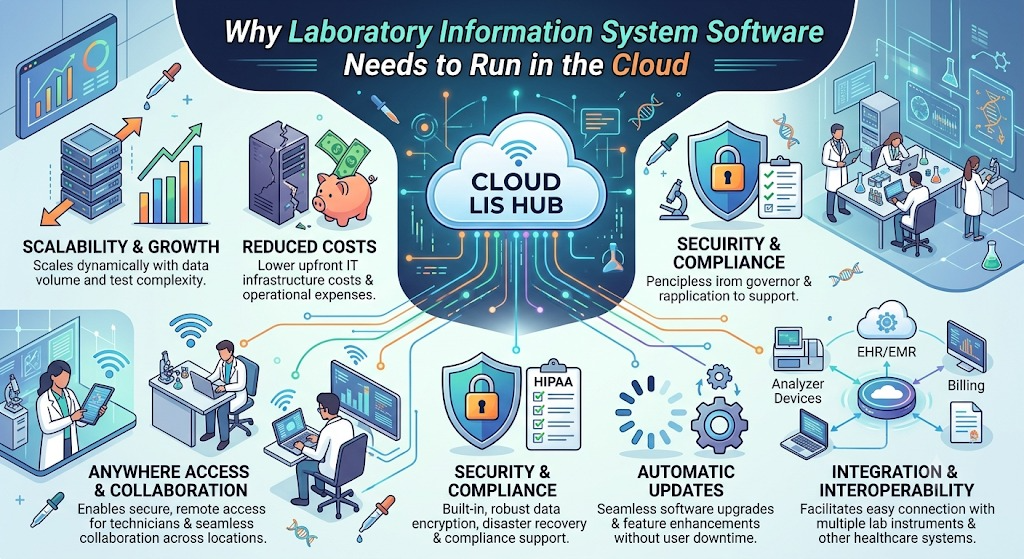
For decades, laboratory information systems lived on servers in back rooms. The lab bought hardware, licensed the software, hired IT staff to keep it all running, and lived with whatever version they’d installed until the next upgrade cycle. That model made sense in an era when cloud computing was new, internet connectivity was unreliable, and healthcare organizations had real concerns about handing data to outside vendors.
That era is over. The case for running an LIS as SaaS in the cloud is strong enough now that on-premise deployments look more like legacy decisions than active choices. Here’s why the shift is happening and what labs gain by making the move.
Lower Costs Upfront and Over Time
The financial math on on-premise LIS deployments is brutal once you add everything up. Servers, storage, networking gear, database licenses, backup systems, and the IT staff to maintain all of it add up to six figures before the lab processes a single case. Then you do it again every 5 to 7 years, when the hardware ages out and the software needs a major upgrade.
SaaS pricing turns that capital expense into a predictable subscription. There’s no hardware to buy, no server room to maintain, no database licenses to renew, no big upgrade projects every few years. The lab pays a monthly or annual fee and gets a working platform. Total cost over a five- or ten-year window often comes out lower than on-premises, and even when it doesn’t, the cost profile is easier to budget for and to scale up or down as the lab grows or changes.
For smaller labs, the difference is even bigger. A solo pathology practice or a community hospital lab can run a modern SaaS platform for what an on-premise deployment used to cost, just for IT staff time. That’s opened up access to good software for labs that used to be stuck with whatever they could afford to install and maintain themselves.
Updates That Actually Reach the Lab
On-premise software lives frozen in time between upgrades. The vendor releases new features, fixes bugs, and patches security holes, but none of it reaches the lab until someone schedules a maintenance window, takes the system down, runs the upgrade, tests everything, and brings it all back up. The process is disruptive enough that many labs run versions years behind the current release, missing out on improvements that have been available the whole time.
SaaS-based LIS platforms like NovoPath update continuously. New features show up in the interface. Bug fixes go out the moment they’re ready. Security patches deploy without anyone scheduling downtime. The lab is always on the current version, which means staff benefit from improvements without the pain of upgrade projects.
The flip side is less control over when changes show up. A workflow your staff use every day might look slightly different on a Monday morning because the vendor pushed an update over the weekend. Good vendors handle this by providing advance notice and configuration options, so changes feel like progress rather than disruption. But the model only works when the vendor takes that responsibility seriously, which is one of the things to evaluate carefully when picking a SaaS platform.
Access From Anywhere With a Browser
On-premises systems reside where the servers are. A pathologist working from home, a lab director checking dashboards from a conference, a histotechnologist looking up a case from a different building. None of those used to be straightforward. VPNs, remote desktop tools, and various workarounds existed, but they were clunky and slow.
SaaS platforms run in a browser. The pathologist signs in from a home office and the platform works exactly the same as it does in the lab. The director pulls up dashboards on a hotel laptop without thinking about it. The histotech looks up a case from any workstation in the building. Subspecialty coverage across locations stops being a logistical headache and becomes a normal part of the workflow.
This has changed how labs operate in ways that go beyond convenience. Remote sign-out is now standard practice in many groups. Pathologists in tight recruiting markets can work from wherever they live and serve labs anywhere. Multi-site pathology groups can balance workload across locations without moving slides or staff. None of that works well with on-premise software, and most of it depends on cloud delivery.
Better Security Through Better Infrastructure
Healthcare organizations used to worry that moving data to the cloud meant losing control of it. The reality has flipped. Major cloud providers like AWS, Azure, and Google Cloud invest billions of dollars in physical security, network defense, threat detection, and compliance programs that no individual lab could match.
A SaaS LIS running on that infrastructure inherits a level of protection that on-premise deployments rarely achieve. Data is encrypted at rest and in transit by default. Backups are geographically distributed and tested regularly. Access controls follow modern best practices. Security patches reach the platform within hours instead of months.
The lab still has to pick a vendor that uses the underlying infrastructure responsibly. Misconfigured cloud setups, sloppy access controls, and weak key management can undo the benefits the cloud provider offers. But vendors taking SaaS seriously also tend to take security seriously, and third-party audit frameworks like SOC 2 Type II and HITRUST give labs a way to verify vendors’ claims rather than take them on faith.
Compare that to a typical on-premise deployment where servers sit in a closet behind the lab, patching depends on overworked IT staff, and the last security audit happened whenever the last accreditation visit demanded one. The on-premise model used to feel safer because the data was physically in the building. In practice, it usually wasn’t.
Integration With Everything Else the Lab Connects To
Modern pathology depends on connections. The LIS has to talk to the EHR, the billing system, digital pathology scanners, instruments, reference labs, molecular platforms, and increasingly to AI tools and tumor board systems. Building and maintaining those connections used to mean custom interfaces, interface engines, and ongoing maintenance work for every endpoint.
SaaS platforms come with APIs and prebuilt integrations for the systems labs actually use. Connecting to Epic, Cerner, or a digital scanner is closer to configuration than custom development. New integrations get added across the vendor’s customer base and become available to every lab on the platform.
That matters because pathology is moving toward a more connected workflow where images, structured reports, molecular results, and clinical context all need to flow together. Labs running cloud platforms have a real head start on getting there. Labs working from on-premises systems with custom interfaces face a harder path, with every new connection requiring its own project and maintenance burden.
A Foundation for AI and Advanced Analytics
AI tools for image analysis, decision support, quality assurance, and operational optimization are getting more capable every year. Most of them are built to work with cloud-based data platforms and APIs. Plugging them into a SaaS LIS is straightforward. Plugging them into a legacy on-premise system is often a multi-month project that may or may not work in the end.
The same is true for analytics. SaaS platforms collect clean, structured data as a byproduct of their regular work, and they expose it through dashboards and APIs that lab leadership can actually use. Spotting a turnaround time trend on Monday morning is a platform feature, not a custom report someone has to build.
Labs investing in the future of pathology are investing in cloud-based infrastructure, whether they realize it or not. The AI tools, the analytics platforms, the integration partners, and the technologies coming next are all being built for a cloud-first world. On-premise systems will fall further behind every year, not because they’re getting worse but because the rest of the ecosystem is moving past them.
Disaster Recovery That Actually Works
On-premise LIS deployments depend on the lab’s ability to recover from disasters. A fire, a flood, a ransomware attack, or a server failure can take the system down for days or weeks. Many labs have disaster recovery plans on paper that have never been tested in practice, and the gap between the plan and the reality often shows up at the worst possible moment.
SaaS platforms build disaster recovery into the infrastructure. Data is replicated across multiple geographically separated locations. Backups are tested as part of the vendor’s regular operations. Recovery time objectives get committed to in the contract and audited by third parties. When something goes wrong, the lab can usually continue working from any location with internet access while the vendor resolves the underlying issue.
Ransomware, in particular, has hit healthcare hard over the past few years, and the calculus on on-premises vulnerability has shifted. Labs running their own servers are running their own risk. Labs on SaaS platforms benefit from vendors whose entire business depends on staying secure and operational, and who have the resources to actually do so.
Scalability That Matches the Lab’s Growth
Labs change over time. Volume grows. New subspecialties get added. Mergers and acquisitions bring new locations into the fold. New testing modalities come into the mix. On-premises systems handle growth by buying more hardware, adding more licenses, and running capacity planning exercises that consistently underestimate what the lab actually needs.
SaaS platforms scale with the lab. Adding users is a configuration change. Bringing on a new location is a matter of provisioning access. Handling a volume spike happens automatically in the background, without anyone scrambling to add servers. The lab pays for what it uses and grows without having to predict its needs years in advance.
What’s Left for On-Premise
On-premise LIS deployments still exist, and there are narrow cases where they make sense. Some very large health systems have invested heavily in their own infrastructure and prefer to keep everything in-house. Some labs in markets with unreliable internet connectivity need local resilience the cloud can’t provide. Some organizations have regulatory or contractual obligations that limit where data can live.
For most labs, though, those exceptions don’t apply. The decision to stay on-premise or move to the cloud isn’t really a decision between two equivalent options anymore. It’s a decision between the technology of the next decade and that of the last.
Pathology is going to keep getting more digital, more connected, more data-driven, and more dependent on AI and analytics. The labs that already run on cloud platforms will continue to move forward. The labs still on on-premise systems will spend more of their energy keeping the lights on instead of moving the lab ahead. The gap will keep widening, and the cost of waiting will keep going up.
Operating a laboratory information system in the cloud isn’t a trend. It’s the model the rest of the lab’s world is being built around, and the labs that lean into it now will be the ones positioned for whatever comes next.