


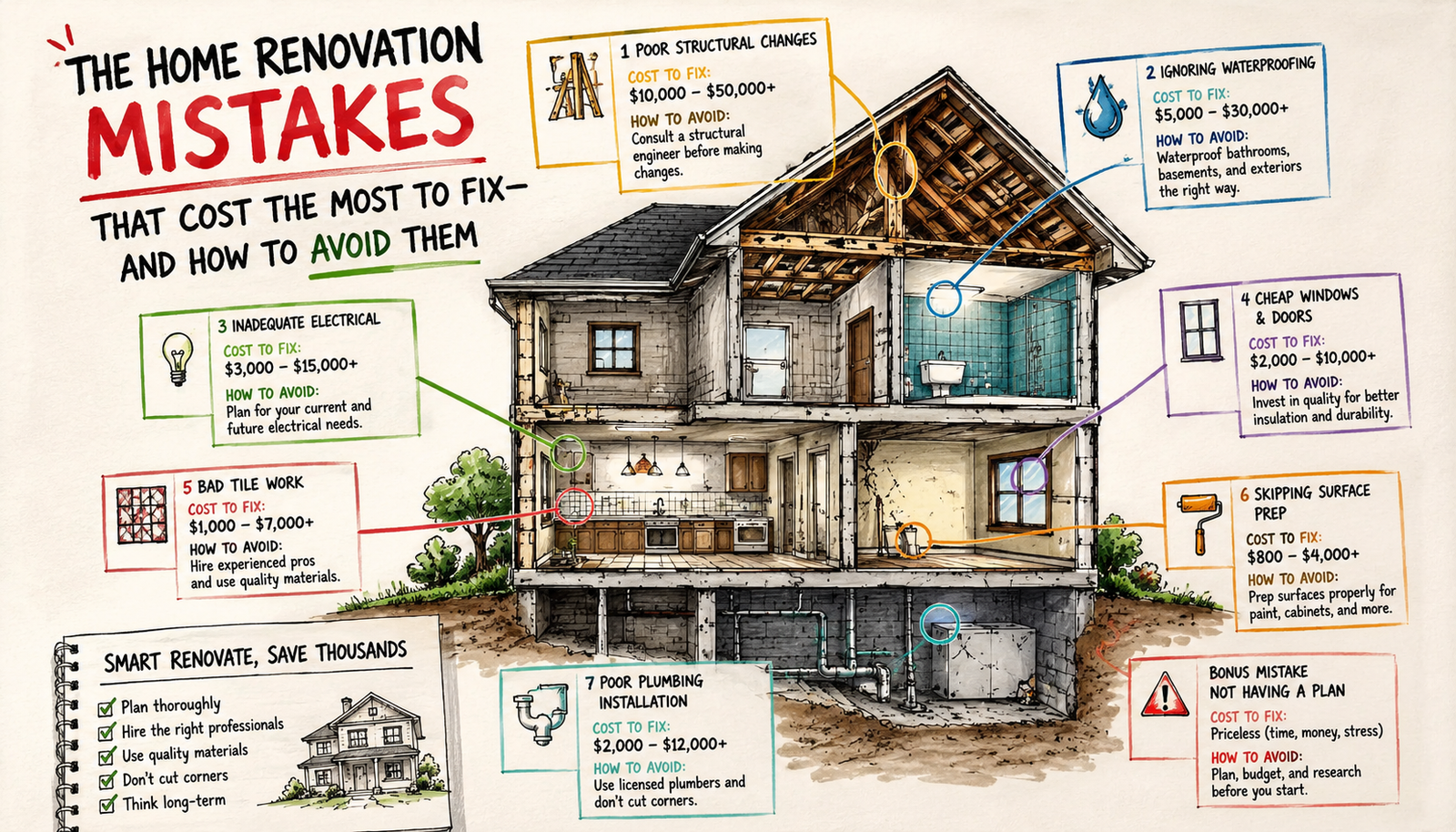
Home renovation projects have a well-earned reputation for going over budget. The national average overrun sits somewhere around twenty percent, and for projects where the homeowner made key decisions without adequate research, the number is often much higher. The irony is that the most expensive mistakes are rarely the ones that feel risky at the time. They are the shortcuts that seem reasonable, the cost savings that look smart on paper, and the assumptions that go unchallenged because nobody asked the right question early enough.
Choosing Materials Based on Price Instead of Lifecycle Cost
This is the single most common mistake in home renovation, and it plays out across every category of exterior and interior work. The homeowner who selects the cheapest option available — whether for flooring, countertops, or exterior systems — saves money on the invoice and pays it back through earlier replacement, higher maintenance, and lower resale value. Understanding lifecycle cost means researching which products actually perform over ten to twenty years in your specific conditions. Resources that compare options like the best roofing material by durability, warranty coverage, and climate suitability help homeowners make decisions that cost less over the life of the home even when the upfront number is higher.
The math is simple but counterintuitive for most buyers. A product that costs twice as much but lasts three times as long is cheaper per year of service. A product that costs less but requires repainting or resealing every three years accumulates labor and material costs that exceed the premium alternative within a decade. Thinking in annual cost of ownership rather than purchase price is the single mental shift that produces the best financial outcomes in renovation decisions.
Where This Mistake Hurts the Most
The categories where material quality has the most disproportionate impact on long-term cost are exterior systems — roofing, siding, windows — because they are exposed to weather continuously and because replacing them involves significant labor cost regardless of what product goes on. A cheap roof that fails five years early triggers a full re-roofing project that costs the same in labor whether the shingles are premium or entry-level. The material savings on the first installation vanishes entirely when the second installation is required sooner than it should have been.
The Renovation Mistakes That Experienced Contractors See Most Often
Contractors who have been in the business for decades see the same homeowner mistakes repeated with remarkable consistency. The patterns that generate the most avoidable expense include:
- Skipping permits to save time and money — unpermitted work creates complications at resale that cost far more to resolve than the permit fee. Buyers’ attorneys in competitive markets routinely check permit histories, and unpermitted structural or exterior work triggers renegotiation or deal cancellation.
- Hiring the cheapest bid without understanding what it excludes — the lowest estimate is almost always lowest because something has been left out, assumed away, or will appear as a change order once the project is underway. Comparing bids only works when you understand what each one actually commits to.
- Making design decisions during construction — changes made after work has started cost dramatically more than the same decisions made during planning. Demolishing and rebuilding work that was done correctly but to a specification the homeowner changed their mind about is pure waste.
- Renovating cosmetics before addressing structure — the kitchen remodel that goes on top of a plumbing system that needs replacement, or the bathroom renovation that covers over moisture damage rather than fixing it. The cosmetic work has to be torn out when the structural issue is finally addressed.
- Ignoring the building envelope in favor of interior upgrades — a new kitchen in a house with failing windows, inadequate insulation, and aging siding is a good kitchen in a house that is losing value and costing too much to heat. The envelope comes first because it protects everything inside it.
The Change Order Trap
Change orders during construction are the single largest source of budget overruns in renovation projects. Some are unavoidable — conditions discovered behind walls that could not have been anticipated. Many are the result of decisions that were deferred during planning and then made under the time pressure of active construction, when the cost of any option is higher than it would have been during the design phase.
The practical defense against unnecessary change orders is thorough planning. Every decision that can be made before construction starts should be. Every material should be selected and confirmed. Every detail that the contractor flagged as a question should be answered. The homeowners who experience the fewest change orders are the ones who treated the planning phase as the real work and the construction phase as execution of a plan that was already complete.
The Sequence That Experienced Homeowners Follow
Homeowners who have been through multiple renovation projects develop an instinct for sequencing that first-timers lack. The sequence that consistently produces the best results: structural issues first, then building envelope, then mechanical systems, then interior finishes. Each layer protects the investment made in the layers above it.
A roof replacement before a kitchen remodel. Window replacement before bathroom tile. Foundation repair before hardwood floors. This sequence feels counterintuitive because the interior finishes are the improvements that are most immediately enjoyable. But the homeowner who installs beautiful floors in a house with a leaking roof discovers the flaw in their sequence the hard way.
When to Renovate and When to Wait
Not everything that could be improved needs to be improved right now. The financially optimal approach to renovation is to address items that are actively deteriorating or creating damage immediately, plan for items that are approaching the end of their service life within the next two to three years, and defer items that are functional but not aesthetically ideal until budget allows without creating financial strain. This triage discipline prevents the common trap of taking on too much at once, stretching the budget past the point where quality can be maintained across all the work being done simultaneously.