


When people say they do not have a game idea, they almost always mean something more specific. They mean they do not have an idea that they are confident will work. Or one they feel is original enough. Or one that they believe they could actually build without it collapsing under its own weight. The idea itself — the raw creative starting point — is almost never the genuine obstacle.
The ten ideas below are real, buildable, and varied enough to suit genuinely different creative instincts and design interests. Each one is a legitimate game concept that can go from description to playable prototype on an AI game maker like Combos in a single session. None of them requires a large team, a significant budget, or prior game development experience. The barrier to starting on any of them is minimal. The only question is which one resonates with how you want to spend the next few hours.
Ideas 1–3: Fast Wins for Absolute Beginners
These three ideas are built for speed. Each has a simple, unambiguous core mechanic, a short development path on Combos, and produces a playable result that feels like a complete experience rather than an unfinished prototype.
Idea 1 — Colour Match Platformer: A side-scrolling platformer where the player changes their character’s colour to match moving platforms. Wrong colour means falling through; right colour means solid ground.
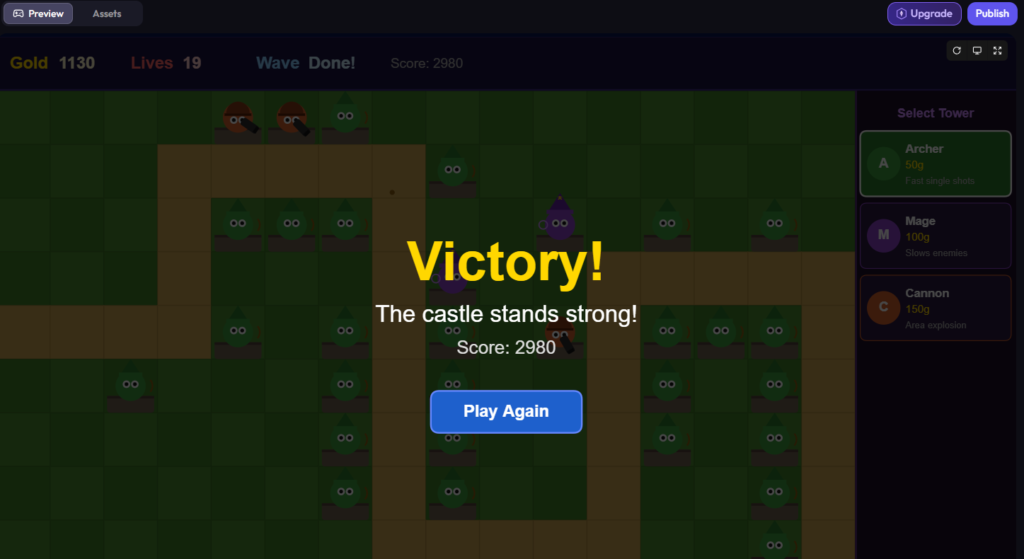
Idea 2 — Memory Tower: A tower defence game where approaching enemies are invisible until they reach a certain distance from the endpoint. Players must observe early waves to understand what is coming, then plan their towers based on memory and pattern recognition. The memory mechanic adds strategic depth without adding mechanical complexity.
Idea 3 — One Button Adventure: A narrative adventure controlled entirely by a single button, where timing determines which options are selected. The constraint forces the design to prioritise storytelling, atmosphere, and moment-to-moment pacing — making it an excellent first project for creators who think of themselves primarily as writers.
Ideas 4–6: Mid-Scope Projects With Room to Grow
These three concepts have more structural complexity than the first set and create room for the creator to expand the game’s scope as confidence and ambition grow.
Idea 4 — Travelling Merchant Idle: An idle game where the player manages a travelling merchant who buys goods cheaply in one region and sells them at a profit in another.
Idea 5 — Gravity Puzzle: A puzzle game where each level applies gravity in a different direction — sideways, upward, or at 45-degree angles. The player must route a ball or object to a target using the environment differently in each level. The mechanic produces a genuinely novel feeling from a conceptually simple variation on standard physics.
Idea 6 — Dialogue Detective: A mystery game with no combat, no map, and no inventory — only conversation. The player interrogates NPCs, identifies contradictions in their testimony, and makes an accusation when they believe they have identified the guilty party.
Ideas 7–8: Genre Mash-Ups With Unexpected Results
Genre mash-ups produce some of the most original-feeling game concepts.
Idea 7 — Farming Horror: A farming simulation where the crops are dangerous — growing and consuming resources if not carefully managed, and posing escalating threats if left unattended too long.
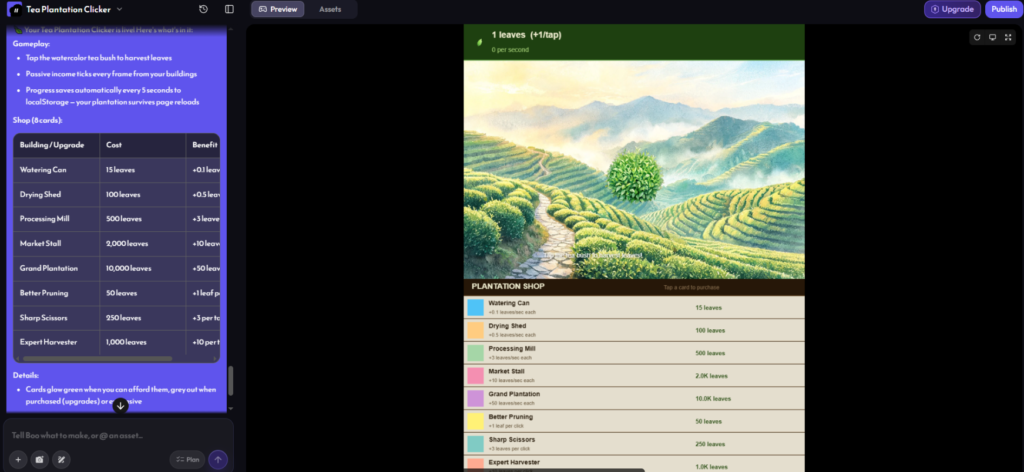
Idea 8 — Roguelite Clicker: A clicker game with procedurally varied upgrade runs. Each session begins fresh with a randomised pool of available upgrades. The session ends at a fixed point rather than running indefinitely.
Ideas 9–10: Ambitious Builds Worth the Extra Effort
These two ideas require more design work, more iteration time, and more deliberate creative decision-making than the previous entries. Both are achievable with an AI game maker and produce portfolio pieces that demonstrate genuine design ambition.
Idea 9 — Generational RPG: An RPG where the player character ages over the course of the game, eventually dying and passing progression to a child character who inherits some but not all of the parent’s relationships, skills, and reputation. The mechanic creates genuine emotional investment and produces a game experience that feels fundamentally different from almost every RPG currently on the market.
Idea 10 — Ecosystem Simulator: A sandbox game where the player places species and environmental elements and then observes how they interact without direct control over outcomes. The mechanic rewards patient observation and systems-level thinking, and produces different results each time.
Making Any Idea Distinctly Yours
Any of these ten ideas can be built as described above. The most interesting versions, though, will belong specifically to the creator who builds them. The way to move from “a competent execution of a concept” to “a game that feels like mine” is to make one significant creative choice that no brief description could have anticipated — a specific tonal decision, an unexpected thematic angle, a mechanic variation that shifts the entire feel of the experience.
That one distinctive choice is often the thing players describe when they tell someone else about the game. Start with one of these ideas as your foundation. Then make the decision that makes it unmistakably yours. The idea is the starting point. Where you take it from there is entirely up to you.
Conclusion
Ten ideas. One AI game maker. A single afternoon. That combination is enough to produce a real, playable, shareable game from any one of these concepts. The only remaining variable is whether you start today. Combos is ready when you are — the technical barriers are gone, the creative space is open, and the first prototype is closer than it has ever been.