



There is a deceptive paradox in business: growth is the goal, but growth is also what breaks most companies. When a business is small, the founder often manages the books on a Saturday morning with a coffee and a spreadsheet. But as the business gains momentum, that simple spreadsheet transforms into a hydra of transactions, payroll queries, VAT deadlines, and complex reporting demands.
Suddenly, financial complexity begins to increase faster than revenue. You aren’t just selling a product anymore; you are managing a sophisticated financial entity that requires precision to survive. This is where many ambitious leaders hit a wall. Their internal teams, often composed of a generalist office manager or a lone bookkeeper, become overwhelmed, and the founder is pulled away from strategy to answer questions about expense claims.
To bridge this gap, high-growth companies are moving away from traditional hiring models. Instead, they are turning to outsourced accounting services as a strategic engine to manage this complexity, allowing them to scale without the friction of a bloated internal finance department. This article explores the tangible benefits, the hidden risks of staying in-house, and why the right accounting partnership is often the “secret sauce” of successful scaling.
The Hidden Cost of Managing Accounting In-House
Many business owners hesitate to outsource because they view it as an “extra” expense. However, they rarely perform a true cost-benefit analysis of their current in-house setup. The true cost of an internal finance function is far higher than a single salary.
- The Full Package Cost: Hiring an experienced accountant in the UK involves more than just a base salary. You must account for Employer National Insurance, pension contributions, private health insurance, and bonuses.
- Infrastructure and Software: Every new hire needs a desk, a laptop, and expensive software licenses (such as Sage, Xero, or specialized ERP modules). These costs scale linearly with every new person you add.
- The Recruitment and Training Tax: In today’s competitive market, finding a qualified accountant is expensive and time-consuming. Once they are in the door, you spend months training them on your specific processes, only to start the process over if they decide to move on.
- Management Overhead: Perhaps the most “hidden” cost is the time the founder or CEO spends managing the finance team. If you are spending five hours a week reviewing basic reports or troubleshooting payroll errors, those are five hours not spent on sales, product development, or investor relations.
When finance becomes a bottleneck rather than a resource, the business stagnates. This realization is usually what pushes a founder to look for a more modern, flexible alternative.
What Is Outsourced Accounting (And What It Actually Includes)?
A common misconception is that outsourcing is just “remote bookkeeping.” While bookkeeping is the foundation, modern outsourced accounting services provide a holistic financial ecosystem. It isn’t just about recording what happened yesterday; it’s about providing the data needed to win tomorrow.
A comprehensive outsourcing partner typically handles:
- Core Bookkeeping and Payroll: Ensuring every invoice is tracked and every employee is paid accurately and on time.
- VAT and Tax Compliance: Managing the ever-changing landscape of HMRC regulations, including Making Tax Digital (MTD) requirements.
- Management Accounts: Providing monthly or quarterly reports that break down profit and loss, balance sheets, and departmental performance.
- Cash Flow Management: Identifying upcoming “dry spells” and ensuring the business has enough liquidity to operate.
- Strategic Advisory: Acting as a fractional Finance Director (FD) to help with budgeting and long-term planning.
Crucially, outsourcing does not mean a loss of control. In fact, by using cloud-based tools, founders often have more visibility into their numbers than they did when they were waiting for an internal staff member to finish a manual report.
What Happens If You Don’t Outsource as You Grow?
Scaling a business without a robust financial structure is like building a skyscraper on a sand foundation. It might look impressive for a while, but eventually, the weight will cause it to collapse.
If you continue to rely on antiquated in-house processes during a growth phase, several things happen:
- Financial Errors Compounding: Small mistakes in the early days become massive liabilities when transaction volumes triple.
- Compliance Risk: HMRC does not accept “we were too busy growing” as an excuse for late VAT filings or incorrect payroll submissions. The penalties can be devastating.
- Slower Decision-Making: Without real-time data, you are forced to make decisions based on “gut feeling” or data that is six weeks old. In a fast-moving market, that delay is fatal.
- Scaling Inefficiency: You end up hiring more people just to manage the paperwork, leading to a high “burn rate” that eats into your margins.
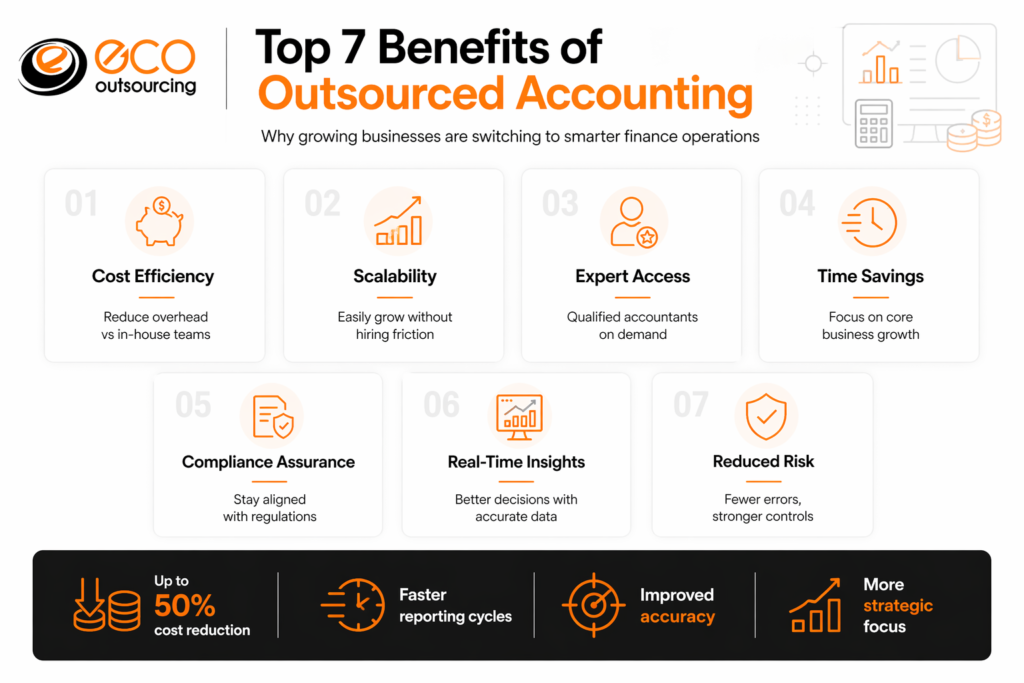
The Top 7 Benefits of Outsourced Accounting
Why are the most successful UK startups and SMEs choosing to outsource? It comes down to these seven pillars of value.
Cost Efficiency Without Compromising Expertise
Outsourcing converts a fixed cost (a full-time salary) into a variable cost. You only pay for the services you need. More importantly, you gain access to a team of specialists, tax experts, payroll pros, and strategic advisors for a fraction of the cost of hiring even one senior executive in-house.
More Time to Focus on Growth
The primary job of a CEO is to lead, not to reconcile bank statements. Outsourcing removes the administrative burden from the leadership team. When you aren’t worried about whether the pension contributions were filed correctly, you can spend your energy on the activities that actually drive revenue.
Improved Accuracy and Compliance
Specialist firms live and breathe accounting standards. They use standardized, audited processes that significantly reduce the risk of human error. They also stay ahead of the curve on legislative changes (like new tax reliefs or employment laws), ensuring your business remains bulletproof against audits.
Access to Advanced Tools and Technology
Individual SMEs often struggle to justify the cost of high-end financial software. An outsourcing partner, however, uses these tools across their entire client base. By partnering with them, you get the benefit of AI-driven data entry, real-time dashboards, and automated reporting without having to manage the tech stack yourself.
Scalable Financial Support
In an in-house model, if your business grows by 50% in six months, your lone accountant will likely quit due to burnout. In an outsourced model, you simply scale your service package. The provider has the “bench strength” to handle your increased volume instantly, providing a seamless transition as you grow.
Better Financial Insights for Decision-Making
Data is only useful if it is interpreted. A quality outsourcing partner doesn’t just give you a P&L; they tell you what it means. They can provide variance analysis (budget vs. actual) and help you understand which of your products or services are truly profitable after all overheads are considered.
Reduced Risk and Greater Control
When one person handles all the money in a small business, the risk of fraud or simple negligence is high. Outsourcing introduces a “separation of duties.” With defined processes and multiple eyes on the accounts, you have a much more secure and transparent financial environment.
Addressing the Biggest Concerns About Outsourcing
Despite the benefits, many founders have valid concerns. Let’s address them directly.
- Data Security: Many worry about their financial data being “out there.” In reality, top-tier outsourcing firms use bank-level encryption and ISO-certified data centers. Your data is often much safer with them than it is on a local office server or a laptop that could be stolen.
- Loss of Control: Founders often feel that if they can’t see the person doing the work, they don’t know what’s happening. The solution is transparency through technology. Cloud platforms like Xero or QuickBooks allow you to log in anytime, anywhere, to see exactly what your balance is.
- Communication: “Will they understand my business?” Modern collaboration tools like Slack, Zoom, and integrated project management software mean your outsourced team can feel like a department in the next room, providing faster responses than an overworked in-house employee.
Outsourced vs. In-House Accounting: A Practical Comparison
| Feature | In-House Accounting | Outsourced Accounting |
| Direct Cost | High (Salary + Benefits + NI) | Flexible (Fixed monthly fee) |
| Depth of Talent | Limited to the hire’s experience | Access to a team of specialists |
| Scalability | Hard (requires new hires/training) | Easy (scale up or down instantly) |
| Technology | Often manual and outdated | Automated and cloud-based |
| Redundancy | High risk if the employee leaves | Low risk (the firm manages staffing) |
How Outsourced Accounting Supports Business Growth
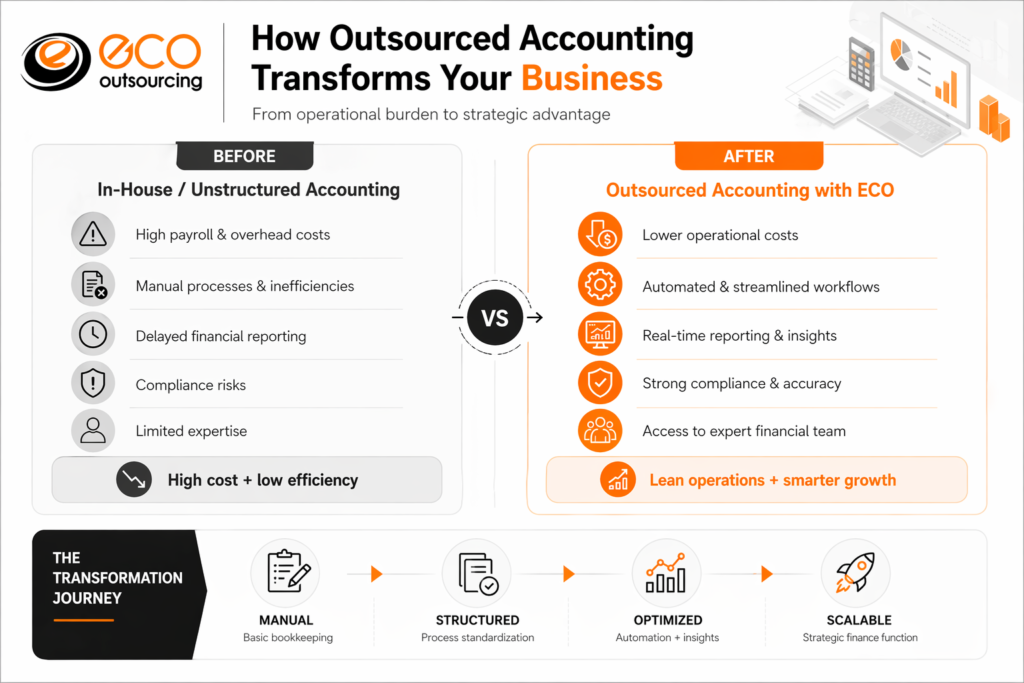
Outsourcing isn’t just about “saving money”; it’s a growth strategy. By removing the “finance bottleneck,” you enable faster decision-making. If you want to expand into a new territory or launch a new product line, your outsourcing partner can quickly model the financial impact, helping you move with confidence rather than hesitation. It provides the structured systems that investors and banks look for, making it easier to raise capital when the time comes.
How to Transition to Outsourced Accounting? (Step-by-Step)
If you are ready to make the switch, follow this roadmap to ensure a smooth transition:
- Assess Your Current Setup: Document your current pain points. Is it payroll? Is it late reporting? Knowing what’s broken helps you choose the right partner.
- Identify Your Needs: Do you need daily bookkeeping, or just high-level FD support?
- Choose the Right Provider: Look for a firm with experience in your specific industry and a strong focus on technology.
- Plan the Onboarding: A good provider will have a transition manager to help migrate your data and integrate with your existing systems.
- Set Communication Rhythms: Decide how often you want to meet (weekly/monthly) and which reports are most critical for your leadership team.
- Monitor and Optimize: After the first 90 days, review the process. You’ll likely find new ways the partnership can add value.
When Is the Right Time to Outsource?
You don’t need to be a giant corporation to benefit from outsourcing. The “sweet spot” is usually when:
- The founder is spending more than 10% of their time on admin/finance.
- The business is planning to hire its first 5–10 employees.
- You are reaching the VAT registration threshold.
- You feel like you are “guessing” your cash flow rather than knowing it.
Common Misconceptions
- It’s only for large companies.False. Startups benefit the most because they need to remain lean and agile.
- Quality is lower than in-house.False. Outsourced firms survive on their reputation and use standardized checklists that most in-house staff don’t have time for.
- It’s just about saving money.While it does save money, the real value is in the strategic insight and risk mitigation.
Frequently Asked Questions
How does outsourced accounting save money compared to hiring in-house accountants?
Hiring a full-time in-house accountant costs £30,000–£50,000 annually plus benefits, training, software, and office space easily £40,000–£60,000 total. Outsourced accounting typically costs £200–£800 monthly (£2,400–£9,600 annually) depending on complexity, providing senior-level expertise without recruitment costs, sick leave cover, or turnover risks. You also avoid software licensing fees since providers use professional systems included in their service. The savings typically cover 50–80% of in-house costs while delivering higher expertise.
What accounting tasks can be outsourced and what should stay in-house?
You can outsource bookkeeping, payroll processing, VAT returns, management accounts, year-end accounts, tax returns, and compliance reporting. Strategic activities like cash flow decision-making, interpreting financial reports for business planning, and board-level financial strategy typically stay with leadership but benefit from outsourced data and insights. The best model is outsourced execution (data entry, compliance, reporting) combined with in-house strategic oversight using the clean, accurate financials your provider delivers.
How quickly can an outsourced accounting provider get set up and start delivering results?
Initial setup typically takes 1–2 weeks including software integration, historical data migration, and process alignment. Most businesses see clean monthly reports within the first month and full service delivery (payroll, bookkeeping, tax compliance) by month two. The transition is far faster than recruiting and training an in-house accountant (3–6 months minimum). Providers handle the heavy lifting while you maintain business continuity with minimal disruption.
Will I lose control or visibility over my finances by outsourcing accounting?
No,modern cloud-based accounting means you have 24/7 real-time access to your financial data through platforms like Xero or QuickBooks. Outsourced providers keep your books updated continuously, giving you better visibility than waiting for in-house staff to process monthly reports. You retain full control over approvals, decisions, and strategic direction while gaining cleaner data, faster reporting, and expert guidance whenever needed.
How does outsourced accounting scale as my business grows?
That’s one of the biggest advantages outsourced providers scale instantly without you hiring additional staff or upgrading systems. Whether you go from 10 to 100 employees, add new revenue streams, or expand internationally, your provider adjusts resources and expertise seamlessly. Growing in-house teams means recruitment cycles, training costs, and capacity planning headaches. Outsourced accounting grows with you automatically, keeping costs proportional to business size.
Conclusion:
Scaling a business will always come with risk but it becomes far more manageable when your financial foundation is strong and forward-looking. As growth accelerates, complexity follows, and relying on stretched internal resources or outdated systems often leads to missed insights, costly errors, and stalled momentum.
That’s why choosing the right partner makes all the difference. As highlighted above, Eco Outsourcing goes beyond routine financial tasks bringing structure, real-time visibility, and strategic direction to your numbers. By turning financial data into actionable insight, businesses gain the clarity needed to make confident, timely decisions that support sustainable growth.
Outsourcing your accounting isn’t about stepping away from control.it’s about strengthening it. With the right expertise, technology, and scalable support in place, your finance function evolves from a back-office necessity into a growth driver. Businesses that simplify and strengthen their financial operations don’t just grow, they grow with confidence, control, and purpose.