


Managing an industrial facility often feels like walking a tightrope. You balance tight production schedules, strict safety protocols, and aging equipment every single day. One of the most stressful parts of the job is managing wastewater compliance.
The scale of industrial discharge failures is staggering. In 2018, the Government Accountability Office estimated that nearly 11,000 industrial facilities and municipal wastewater treatment plants illegally dumped significant amounts of pollution into nearby water bodies. This widespread failure paints a clear picture of how difficult it is to manage industrial runoff.
For the compliance-driven facility manager, the anxiety of a surprise regulatory inspection is very real. You already know that relying on outdated, patched-up infrastructure is a gamble you cannot afford to take. The daily stress of wondering if your discharge water meets stringent environmental standards takes a heavy toll on operations.
The only way to confidently avoid fines and ensure flawless discharge is by upgrading outdated wastewater systems. Facilities must transition to properly engineered, performance-proven technology. Doing so eliminates the guesswork from environmental compliance and protects your company’s bottom line.
The Heavy Cost of Failing EPA Discharge Rules
Regulatory agencies are not simply issuing warnings; they are actively tracking and penalizing environmental failures. The enforcement net is wide and catching thousands of operations off guard. Falling into significant noncompliance brings severe financial consequences that can quickly bankrupt an operation. If a facility receives subsequent convictions for known violations, fines can skyrocket to an incredible $100,000 per day.
Beyond the immediate financial sting, violations bring bad press, forced operational shutdowns, and intense ongoing regulatory scrutiny. Getting off the EPA’s radar is much harder than staying off it in the first place. Once you fail an inspection, every future discharge event is placed under a microscope.
Many compliance failures stem from relying on outdated or improperly sized equipment that cannot handle modern industrial flow rates or effectively remove non-emulsified hydrocarbons. To avoid these costly fines, facilities must upgrade to performance-proven oil water separator technology that is specifically engineered to exceed exacting regulatory standards.
Decoding the Regulatory Landscape
To stay compliant, facility managers must understand the exact metric targets regulators expect them to hit. The federal standard acts as a baseline, but local rules often complicate the picture. The Clean Water Act mandates that industrial wastewater cannot contain more than 100 parts per million (ppm) of oil.
However, many local municipalities and state agencies enforce significantly stricter limits. It is common for local jurisdictions to require discharge levels below 40 ppm. In environmentally sensitive areas, regulators might demand levels drop down to an incredibly strict 10 ppm.
Federal guidelines also dictate how equipment must be sized to meet environmental exemptions. The EPA SPCC Guidance for Regional Inspectors on Oil/Water Separators details strict requirements. Separators must be appropriately sized to handle both oil and precipitation to successfully meet secondary containment and wastewater treatment exemptions.
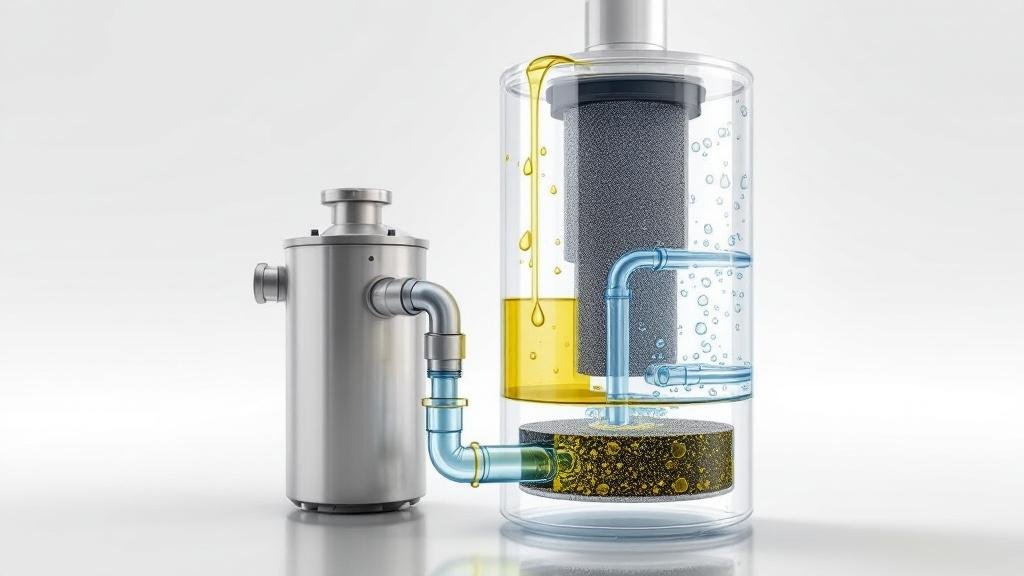
These regulations specifically target “non-emulsified hydrocarbons.” In simple terms, these are free-floating oils and greases that do not chemically mix or dissolve into water. They naturally separate and float to the surface under the right physical conditions, making them the primary focus of gravity-based separation technology.
Why Legacy Systems Fail to Remove Non-Emulsified Hydrocarbons
If non-emulsified hydrocarbons naturally float, you might wonder why older treatment systems still fail EPA inspections. The core reason outdated separators fail is simple. They were never engineered for the high-capacity, modern flow rates today’s industrial facilities produce.
Effective separation requires time. The physical process relies on water sitting quietly enough for oil droplets to rise to the surface. When flow rates exceed a legacy system’s physical capacity, this required retention time vanishes.
The resulting turbulence rushes the separation process completely. High-velocity water pushes oil droplets straight through the tank before they have a chance to float. These non-emulsified hydrocarbons then bypass the internal media and exit directly into your discharge water.
Failing to properly size a system to your facility’s current actual output guarantees failure during a regulatory inspection. An undersized tank creates an operational bottleneck that compromises the entire treatment process. Upgrading means calculating your true maximum flow rate and choosing a system built specifically for that volume.
Engineering the Right Solution: Pump Feed vs. Gravity Flow
Choosing the correct separator configuration is the most important step in the upgrade process. A system that works perfectly for a small indoor wash bay will fail miserably at a heavy-duty outdoor processing plant. Facility managers must choose between pump feed and gravity flow designs based on their unique site layout.
The following table breaks down the three primary installation types and their ideal industrial applications.
| Separator Configuration | Flow Type | Capacity Range | Ideal Application & Site Conditions |
|---|---|---|---|
| Above Grade Separators | Pump Feed | 0 to 400+ GPM | Designed for indoor or outdoor spaces where wastewater is pumped directly into the unit. |
| Flush-With Grade Separators | Gravity Flow | 0 to 5000 GPM | Fiberglass systems used in designated, non-traffic areas where natural gravity moves the water. |
| Below Grade Separators | Gravity Flow | Up to 5000 GPM | Heavy-duty systems built for deep burial, drive-over traffic, and massive flow volumes. |
Above grade separators are incredibly versatile for facilities with tight spatial constraints. These are designed for pump feed applications where water is mechanically lifted into the tank. They comfortably handle flow rates ranging from 0 to 400+ GPM.
Flush-with grade separators offer a streamlined approach for facilities relying on natural water flow. These fiberglass units are designed specifically for gravity flow applications in designated areas away from heavy vehicle movement. They accommodate much larger volumes, handling capacities anywhere from 0 to 5000 GPM.
Below grade separators are the absolute workhorses of the wastewater industry. Highlighted as heavy-duty gravity flow units, they are explicitly built for deep burial and drive-over conditions. They manage massive industrial flow rates up to 5000 GPM while remaining completely out of the way of daily surface operations.
Ultimately, choosing the right system depends entirely on your site’s existing plumbing. You must evaluate your spatial constraints, required flow volumes, and the necessary engineering approach. A mismatched system will lead directly back to the compliance headaches you are trying to escape.
Conclusion
Sticking with outdated legacy equipment is a massive financial and legal gamble. Modern industrial facilities simply cannot afford the risk of significant noncompliance. The daily anxiety of an unexpected inspection combined with the threat of six-figure fines makes upgrading an absolute necessity.
The clear path to flawless discharge compliance requires moving away from patchwork fixes. Facility managers must embrace performance-proven technology tailored precisely to their spatial and flow-rate requirements. Choosing the correct pump feed or gravity flow system ensures non-emulsified hydrocarbons are effectively captured every single time.
Do not wait for an environmental agency to mandate an emergency equipment replacement. Taking control of your discharge technology today guarantees operational peace of mind and total regulatory compliance tomorrow.