


The standard advice for someone who wants to get into game development has been consistent for years: pick an engine, follow tutorials, build small things, and gradually work your way up to bigger projects. It’s solid advice. It’s also advice that most people who try it don’t follow all the way through. The drop-off rate between ‘started watching tutorials’ and ‘finished a game’ is significant — not because people aren’t committed, but because the gap between learning an engine and making something you actually want to play is larger than most tutorial series suggest.
Starting with an AI game agent inverts that sequence in a useful way. Instead of learning the tools and then making the game, you make the game first and learn what you need as you go. The agent handles the technical execution so you can focus on the thing that matters most at the beginning: figuring out what kind of games you want to make and what design decisions go into making them good. For creators drawn to vibe coding game approaches — where feel and atmosphere come first — this inversion is especially natural. You’re not blocked by technical knowledge. You’re free to experiment from day one.
The Game Engine Learning Curve Nobody Warns Beginners About
Game engines are extraordinary pieces of software. They’re also built for people who already know what they’re doing. The documentation assumes familiarity with programming concepts. The tutorials cover the mechanics of the engine rather than the craft of making games. And the gap between ‘understanding how the engine works’ and ‘making a game that’s fun to play’ is something most tutorial series quietly skip over.
Students who want to build a strong foundation in computer applications and modern technologies can consider an online bca course. This flexible degree program helps learners develop essential skills in programming, software development, artificial intelligence, and data science while allowing them to study remotely. With industry-focused learning and specialized tracks, an online BCA can be a valuable step for beginners planning a career in the technology sector.
Beginners often spend months learning an engine without making a single thing they’d want to show someone. That’s not wasted time exactly — they’re building foundational knowledge. But it’s a slow, abstract process that provides very little of the feedback and satisfaction that comes from actually finishing something.
What You Actually Want to Learn First
Game design thinking — how to construct a compelling loop, how to pace difficulty, how to make players feel clever rather than stuck — is more transferable and more immediately useful than engine knowledge. It’s also something you can only really develop by making games and playing them, not by reading about them.
An AI game agent lets you develop design thinking from the very beginning, because you’re making real games and seeing how real players respond to your decisions. The engine knowledge can come later, once you know what you’re trying to build and have some experience judging whether a game actually works.
A Beginner’s First Session With Combos’ AI Agent
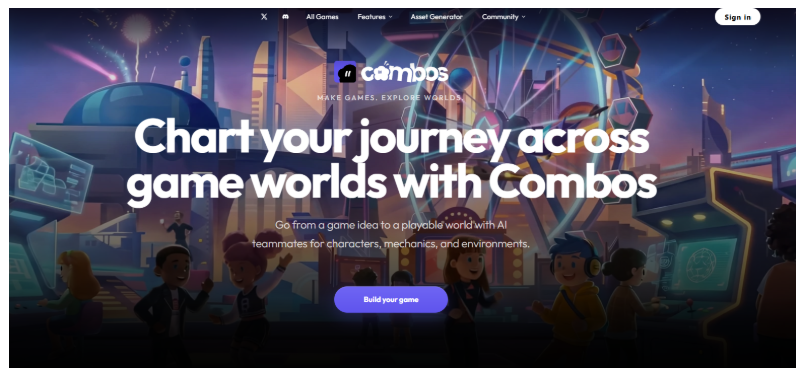
Step 1: Skip the engine tutorials for now — open combos.fun, and start a blank project
Don’t spend any time on setup, documentation, or configuration. The platform is designed to get you to creative work immediately. The blank project is your starting point — bring an idea, even a rough one.
Step 2: Tell Boo what you want your game to feel like, not what you want it to technically do
Beginners often reach for technical descriptions because they think that’s what’s needed. It isn’t. ‘I want a game that feels tense and claustrophobic, set underground’ gives the agent better working material than ‘I want a top-down game with a 32×32 tileset and a stealth mechanic’. The technical stuff follows from the feeling. Start with the feeling.
Step 3: Let Boo build the prototype — your job is to react to what it produces
Don’t intervene during the build. Let the agent complete its work and then play what it made before you change anything. Your unfiltered reaction to the first build is valuable information about whether the concept works and what needs attention.
Step 4: Ask yourself what you’d change and why — that answer is game design in practice
Every time you notice something that feels off, and you can articulate why, you’re doing game design thinking. ‘The controls feel heavy but the level design assumes agility’ is a design observation. ‘The visual style doesn’t match the tone of the story’ is a design observation. Collecting those observations and acting on them is the practice you’re building.
What Beginners Get Wrong When They Start With Engines
The most common mistake is conflating learning the engine with learning game development. They’re related but distinct. You can become fluent in Unity or Godot without developing strong design instincts. You can also develop excellent design instincts using tools that abstract away the technical layer entirely.
The second common mistake is staying in tutorial mode too long. Tutorials teach you what the engine can do. They don’t teach you what your game should do. At some point, you have to stop learning and start making — and for most beginners, that transition is easier when the first thing they make doesn’t require them to also wrestle with an unfamiliar technical environment.
Using Agent-Built Games as a Bridge to Deeper Learning
The intent isn’t to stay with an AI agent forever. It’s to build a foundation of design experience that makes everything else easier when you’re ready for it. A beginner who has made and shipped five games using an agent — who has playtested them, gathered feedback, and iterated based on what wasn’t working — will approach a game engine with much clearer questions and much more patience for the learning process.
They’ll know what they’re trying to build. They’ll know what good feels like. Those two things change the engine-learning experience completely.
The Fastest Route to Knowing Whether Game Development Is for You
One thing the agent-first approach provides that the engine-first approach doesn’t is an early, honest answer to the question of whether game development is something you want to pursue seriously. Making games and seeing how players respond to your decisions is the experience, not learning software.
If you go through the process of making a few games with an agent and find you love it — the design thinking, the iteration, the satisfaction of watching someone play something you made — then you know what you’re committing to when you start learning an engine. If you find it’s not for you, you discovered that in a few weeks rather than a few months.
Conclusion
Game engines are where advanced development happens. But advanced development isn’t where game development starts — it’s where it goes after you understand what you’re building and why. The AI game agent gets you making real games immediately, developing the instincts and experience that every good developer needs, without the technical barrier that stops most beginners before they get started.