


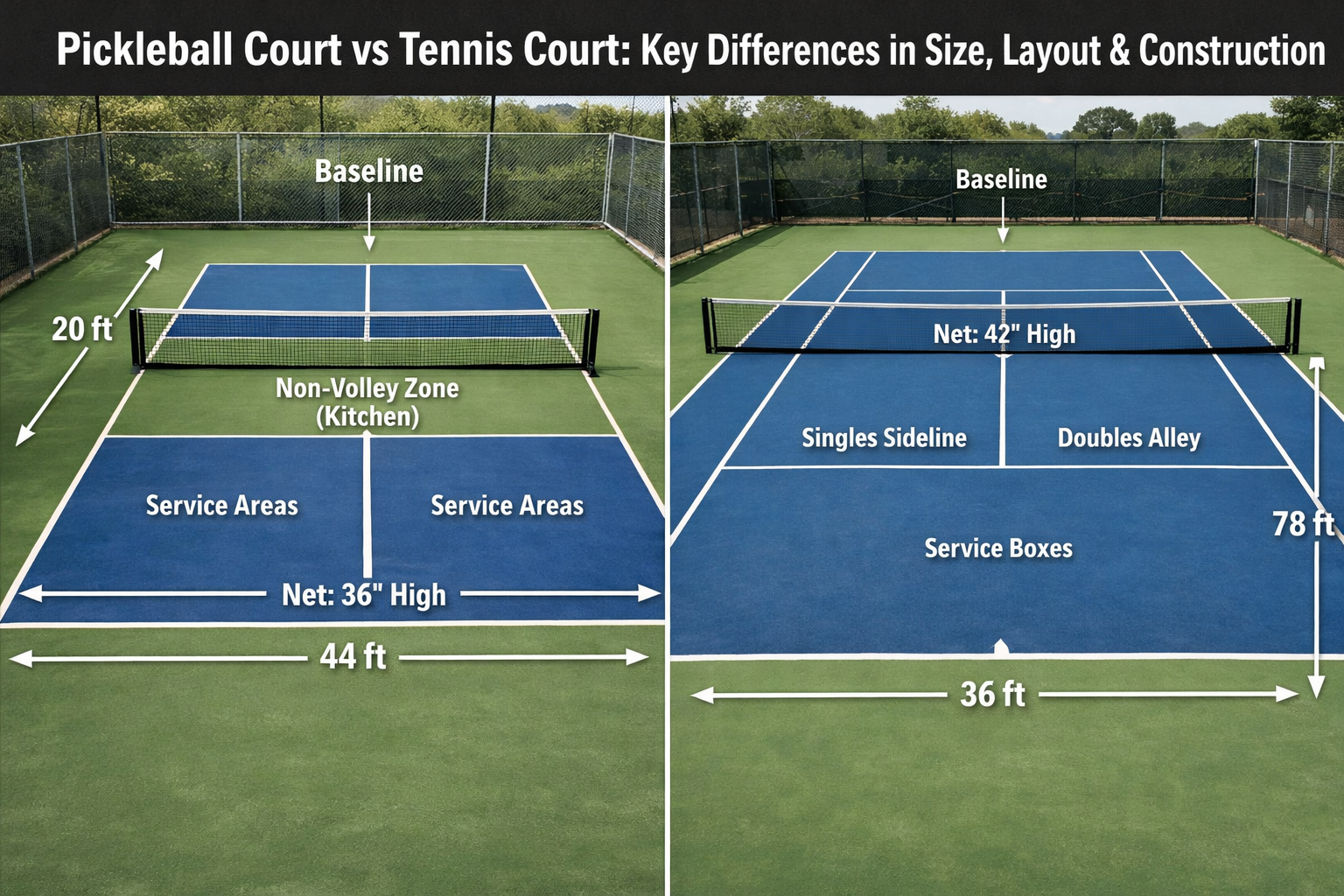
As pickleball continues to grow in popularity, many homeowners, schools, and recreational facilities are comparing pickleball courts and tennis courts to determine which better fits their space and goals.
While both sports share similar visual layouts, the differences between a pickleball court and a tennis court go far beyond scale. Court dimensions, construction requirements, surface wear, and long-term maintenance vary significantly.
Understanding these differences helps property owners make informed planning decisions before construction begins.
1. Court Size: The Most Noticeable Difference
The biggest distinction in the pickleball court vs tennis court comparison is size.
Tennis Court Dimensions
- 78 feet long
- 36 feet wide (doubles)
- Recommended total area: 120 × 60 feet including run-off
Pickleball Court Dimensions
- 44 feet long
- 20 feet wide
- Recommended total area: 30 × 60 feet including clearance
The dramatic difference in pickleball court vs tennis court size makes pickleball more accessible for smaller residential properties.
For detailed layout planning, understanding official outdoor pickleball court dimensions and layout ensures proper compliance and safety spacing.
2. Construction Requirements
Although both courts may use similar base materials, construction standards differ.
Tennis Court Construction
- Larger excavation footprint
- More extensive drainage planning
- Higher material volume
- Greater surface expansion impact
Pickleball Court Construction
- Smaller base preparation
- Easier integration into residential yards
- Lower material volume
- Faster installation timeline
Working with experienced design professionals ensures that both tennis courts and pickleball courts are built with correct grading and slope integration.
3. Surface Performance and Wear
Because tennis courts cover significantly more surface area, material expansion and contraction play a larger role in long-term durability.
Pickleball courts, due to compact size, may experience concentrated wear in high-traffic zones.
Learning about proper resurfacing techniques through a professional tennis court resurfacing guide helps owners understand maintenance expectations for both surfaces.
4. Player Movement and Game Dynamics
Tennis emphasizes:
- Baseline rallies
- Wide lateral movement
- Long sprint distances
Pickleball emphasizes:
- Shorter court coverage
- Net-focused play
- Quick reaction zones
These gameplay differences influence layout choices, buffer spacing, and fencing placement.
5. Multi-Sport Conversion Possibilities
One of the most common questions is whether a tennis court can accommodate pickleball lines.
The answer is yes, but careful layout planning is required to avoid visual confusion and maintain play quality.
Professional court planners assess:
- Available width
- Line color contrast
- Net system compatibility
- Long-term surface marking impact
For property owners evaluating new installations, experienced court design teams like Pine State Courts help determine whether building a dedicated pickleball court or maintaining a tennis court offers better long-term value.
6. Space Efficiency for Residential Projects
For many homeowners, the primary deciding factor is available yard space.
A full tennis court requires substantial land, while a pickleball court fits comfortably within many suburban properties.
Exploring professional pickleball courts design options allows homeowners to integrate sport surfaces without overwhelming landscaping or drainage systems.
Final Thoughts
When comparing pickleball court vs tennis court options, the decision ultimately depends on space, usage goals, and long-term maintenance planning.
Tennis courts offer traditional regulation play and larger performance space, while pickleball courts provide accessibility, compact design, and easier residential integration. Understanding these structural and dimensional differences ensures that construction decisions align with both property limitations and long-term performance expectations.