


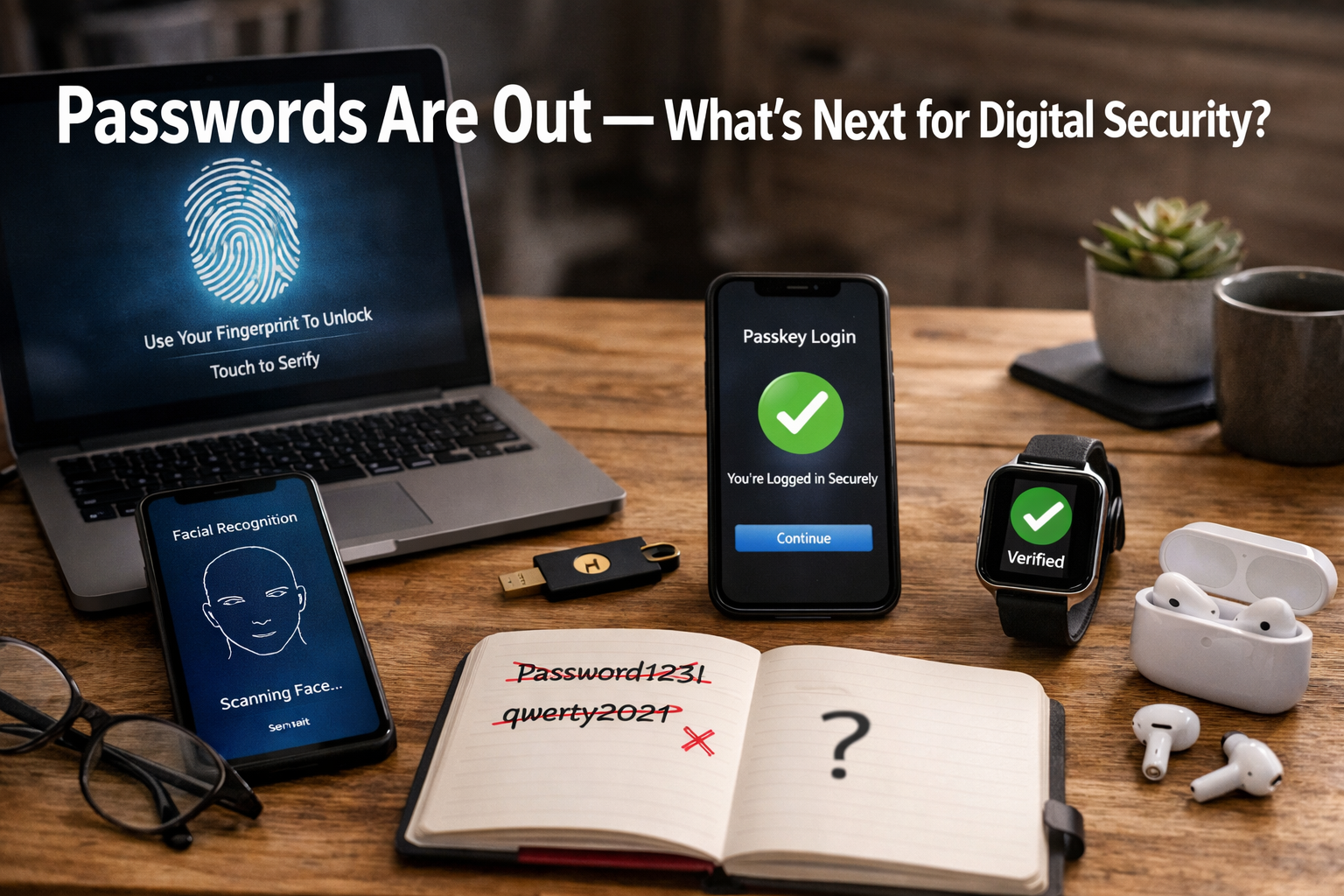
Passwords, once central to online security, now represent its biggest liability. Massive data leaks, AI-driven phishing, and automated credential attacks have exposed how fragile password-based systems truly are. As passkeys and device-based authentication rapidly replace traditional logins across Google, Apple, Microsoft, and major banks, the password era is already fading.
Why Passwords No Longer Work
Passwords no longer fail because users are careless. They fail because the threat landscape has evolved. Even strong, unique passwords become useless when company databases are breached or when attackers deploy advanced phishing systems that capture credentials in real time.
Users are more security-aware today. Many rely on password managers and avoid reuse. Yet attackers bypass security controls through cloned websites and automated interception tools. The issue is no longer user behavior; it is the weakness of shared secrets stored on centralized servers.
Security standards have shifted in response. Regulated platforms such as MrQ, which operates under a UK licence, now combine strong regulatory oversight with secure payment systems including PayPal, Visa, Mastercard, and Apple Pay.
The direction is clear: customer trust is no longer built on memorized passwords alone. It now depends on verified identity, licensed infrastructure, and secure transaction frameworks.
Passkeys and Public-Key Authentication
Passkeys replace shared secrets with cryptographic key pairs. When a user creates a passkey on an iPhone, the device generates a private key and stores it in the Secure Enclave. The corresponding public key is registered with the service.
During login, the device signs a challenge from the server. The private key never leaves the device. There is nothing to steal from a fake login page because there is no password.
When signing in to a Google account with a passkey, the user confirms their identity with Face ID or a fingerprint. The authentication process completes without requiring any input. Even if an attacker clones the login page, the passkey will not activate because it is tied to the legitimate domain.
Banks such as Revolut and several European financial institutions now support passkeys for account access. Adoption is expanding beyond tech platforms into finance and enterprise tools.
Biometrics as Unlock Mechanisms
Biometrics do not replace cryptography. They unlock it. When a MacBook user logs in with Touch ID, the fingerprint scan authorizes access to a locally stored private key. The fingerprint itself is not transmitted to the website.
Modern smartphones use dedicated hardware chips to isolate biometric data. Apple’s Secure Enclave and Android’s Titan M chip store sensitive authentication material separately from the main operating system. Even if malware infects the device, extracting biometric templates is extremely difficult.
Behavioral biometrics add silent monitoring. Some banking apps analyze typing speed and device tilt during login. If the interaction pattern suddenly changes, the system may request additional verification. This method reduces fraud without forcing constant manual input.
Zero-Trust Architecture
Security no longer assumes trust after one successful login. Zero-trust models verify every request in context. A user accessing corporate files from a managed laptop in a familiar location may pass silently. The same user attempting access from a new country on an unknown device triggers extra checks.
Microsoft’s enterprise security platform applies conditional access rules based on device compliance and risk scoring. If antivirus protection is outdated or the operating system is unpatched, access may be automatically restricted.
Cloud services now integrate device health, network reputation, and behavioral analytics into authentication decisions. The password becomes irrelevant when continuous verification replaces static trust.
AI as Defender and Threat
Artificial intelligence now processes login data at a massive scale. Payment platforms analyze transaction timing, spending patterns, and device fingerprints in real time. Suspicious deviations trigger immediate fraud-prevention measures.
For example, if a user who typically logs in from Berlin suddenly attempts to access the system from another continent within minutes, AI systems flag the anomaly immediately. Additional authentication or temporary suspension follows automatically.
Attackers also deploy AI. Deepfake audio has been used in corporate fraud cases where executives were impersonated to authorize transfers. Phishing emails generated by language models can convincingly mimic internal communication styles. Removing passwords reduces one of the easiest targets in this automated attack.
What Changes for Everyday Users
The transition to passwordless systems simplifies daily security. Instead of remembering dozens of credentials, users rely on trusted devices. Enabling passkeys on a Google, Apple, or Microsoft account takes minutes and reduces password exposure risk.
App-based authentication replaces SMS codes in many services. Hardware security keys such as YubiKey provide additional protection for journalists, developers, and corporate employees.
Device updates become critical. Because authentication is tied to hardware security modules, keeping software up to date protects the integrity of stored cryptographic keys. Security shifts from memory management to device management.
The Post-Password Reality
Passwords still exist in legacy systems. Many websites have not completed the transition. Hybrid models remain common, combining passwords with device-based verification.
The direction is clear. Identity verification is moving toward cryptographic proof anchored in hardware. Something you have, combined with something you are, replaces something you know.
Logging in no longer requires typing a secret. It requires proof of possession of a secure device and confirmation of presence. The post-password era is not experimental. It is already integrated into everyday technology, redefining how digital trust works in 2026.